- The war in Ukraine: An ongoing debate
- Introduced by Maurizio Arcari and Beatrice Bonafé
- Giulio Bartolini, The provision of belligerent materials in the Russia-Ukraine conflict: Beyond the law of neutrality?
- Paolo Zicchittu, Article 11 of the Italian Constitution and the war in Ukraine: The constant dialogue between Constitutional and International Law
Wednesday, May 31, 2023
New Issue: Questions of International Law
Call for Papers: Justice in international investment law in a post-ISDS world
New Issue: International Interactions
- Yooneui Kim, A network analysis of naming and shaming in the universal periodic review
- Nazmus Sakib & Md Muhibbur Rahman, Military in the cabinet and defense spending of civilian governments
- Tim Haesebrouck, The populist radical right and military intervention: A coincidence analysis of military deployment votes
- Burak Giray, Troop-providers' ideational commitment to UN peacekeeping and effectiveness
- Yuichi Kubota, Gaku Ito & Masataka Harada, Making sense of violence in semi-technologized conventional civil war: Evidence from nineteenth-century Japan
- Omer Zarpli, Sanctions and target public opinion: Experimental evidence from Turkey
- Mohammad Reza Farzanegan & Hassan F. Gholipour, Russia’s invasion of Ukraine and votes in favor of Russia in the UN General Assembly
Tuesday, May 30, 2023
Krieger & Liese: Tracing Value Change in the International Legal Order: Perspectives from Legal and Political Science
International law is constantly navigating the tension between preserving the status quo and adapting to new exigencies. But when and how do such adaptation processes give way to a more profound transformation, if not a crisis of international law? To address the question of how attacks on the international legal order are changing the value orientation of international law, this book brings together scholars of international law and international relations.
By combining theoretical and methodological analyses with individual case studies, this book offers readers conceptualizations and tools to systematically examine value change and explore the drivers and mechanisms of these processes. These case studies scrutinize value change in the foundational norms of the post-1945 order and in norms representing the rise of the international legal order post-1990. They cover diverse issues: the prohibition of torture, the protection of women's rights, the prohibition of the use of force, the nonproliferation of nuclear weapons, sustainability norms, and accountability for core international crimes. The challenges to each norm, the reactions by norm defenders, and the fate of each norm are also studied. Combined, the analyses show that while a few norms have remained surprisingly robust, several are changing, either in substance or in legal or social validity. The book concludes by integrating the conceptual and empirical insights from this interdisciplinary exchange to assess and explain the ambiguous nature of value change in international law beyond the extremes of mere progress or decline.
New Issue: Zeitschrift für ausländisches öffentliches Recht und Völkerrecht
- Comment
- Armin von Bogdandy, Chilean Insights for Progressive Constitutionalism
- Abhandlungen
- Max Lesch & Christian Marxsen, Norm Contestation in the Law Against War: Towards an Interdisciplinary Analytical Framework
- Ingvild Bode, Contesting Use of Force Norms Through Technological Practices
- Giulia Persoz, Mitigating International Norms Through Contestation: Peaceful Purposes in Space Law and the Security Dilemma
- John-Mark Iyi, Of Norms and Ambiguity: The Contested Authority of UN Security Council and African Union in the Use of Force in Africa
- Aurel Sari, Norm Contestation for Strategic Effect: Legal Narratives as Information Advantage
- Agata Kleczkowska, Prohibition of Threats of Force: A Silently Contested Norm?
New Issue: Nordic Journal of Human Rights
The latest issue of the Nordic Journal of Human Rights (Vol. 41, no. 1, 2023) is out. Contents include:- Special Issue: World Heritage
- Stener Ekern & Peter Bille Larsen, Introduction: The Complex Relationship Between Human Rights and World Heritage
- Carlos Fredy Ochoa García, The K'iche’ Maya Written Tradition and the Cultural Heritage of Totonicapán, Guatemala
- Ave Paulus & Aleksei Kelli, Intangible Cultural Heritage and Intellectual Property Protection as Two Sides of the Same Human Rights Coin: Memoryscapes and Traditional Boatbuilding in Estonia
- Matthew Storey, The Right to Enjoy Cultural Heritage and Australian Indigenous Cultural Heritage Legislation
- Peter Bille Larsen, The Lightness of Human Rights in World Heritage: A Critical View of Rights-Based Approaches, Vernaculars, and Action Opportunities
- Elizabeth Anderson Comer & Margaret Comer, Heritage Communities and Human Rights: A Case Study from Catoctin Furnace, Maryland
- Claudia Uribe Chinen, Unpacking Heritage and Human Rights in Peru: A View from Archaeological World Heritage Management
Monday, May 29, 2023
Conference: 30th Annual ANZSIL Conference
Sunday, May 28, 2023
Longobardo: The Applicability of Apartheid to Situations of Occupation: At the Crossroads between International Humanitarian Law, International Criminal Law, and International Human Rights Law
The article deals with the applicability of apartheid in occupied territory. Rather than assessing whether in specific situation of an occupation an occupying power has established an apartheid regime, the article discusses whether there is anything in the law of occupation or in the international regulation of apartheid that makes them mutually exclusive. On the basis of international human rights law, international criminal law, and international humanitarian law considerations, it is argued that apartheid can be applied to occupied territory following the ordinary rules for the application of international human rights law and international criminal law in occupied territory. Accordingly, international law does not bar the application of apartheid in occupied territory, but rather, the law of occupation and apartheid coincide to strengthen the protection of civilians in occupied territories.
New Issue: European Journal of International Relations
The latest issue of the European Journal of International Relations (Vol. 29, no. 2, June 2023) is out. Contents include:- Naosuke Mukoyama, The Eastern cousins of European sovereign states? The development of linear borders in early modern Japan
- Natalya Naqvi, Economic crisis, global financial cycles and state control of finance: public development banking in Brazil and South Africa
- Johannes Petry, Beyond ports, roads and railways: Chinese economic statecraft, the Belt and Road Initiative and the politics of financial infrastructures
- Leonie Holthaus, Feelings of (eco-) grief and sorrow: climate activists as emotion entrepreneurs
- Laleh Khalili, Humanitarianism and racial capitalism in the age of global shipping
- Megan A. Stewart, Foundations of the Vanguard: the origins of leftist rebel groups
- Benjamin E. Goldsmith & Yusaku Horiuchi, Does Russian election interference damage support for US alliances? The case of Japan
- Paul Beaumont & Elana Wilson Rowe, Space, nature and hierarchy: the ecosystemic politics of the Caspian Sea
- James W. Davis, Better than a bet: good reasons for behavioral and rational choice assumptions in IR theory
- Regan Burles, Kant’s domestic analogy: international and global order
Saturday, May 27, 2023
New Issue: Chinese Journal of International Law
The latest issue of the Chinese Journal of International Law (Vol. 22, no. 1, March 2023) is out. Contents include:- Editorial Comment
- Sienho Yee, Between the “Standard Methodology” in Delimitation Dispute Settlement and the UNCLOS: Some 40th Anniversary Reflections
- Articles
- Agnese Vitale, The Higher Law and the Principle of Non-Recognition
- Zhenni Li, Autonomy of Provisional Measures or Autonomy of the International Court of Justice?
- Comment
- Jianjun Gao, Delimitation of the Extended Continental Shelf in Somalia v. Kenya in the ICJ: A Critique
- Current Development
- Yudan Tan & Suhong Yang, The Joint Investigation Team in Ukraine: An Opportunity for the International Criminal Court?
- Special Section of Letters on Joint Development
- Sienho Yee, Special Section of Letters on Joint Development: An Introductory Note
- Niya Deng, Joint Development Between Australia and Timor-Leste
- Wang Jia, Nigeria-Sao Tome and Principe Joint Development of Petroleum and Other Resources
- Shichen Tian, The Joint Development Agreement between Senegal and Guinea-Bissau: A Summary and Brief Analysis
- Jing Liu, The Japan-Korea Joint Development Agreement: with Particular References to Revising the Deadlock Resolution Mechanism
- Gulardi Nurbintoro, The Timor Gap Treaty
- Sufian Jusoh, Muhammad Faliq Abd Razak, & Ahmad Rizal Mohd Yusof, Malaysia-Thailand Joint Development Agreement
- Muhammad Faliq Abd Razak, Sufian Jusoh, & Andika Ab. Wahab, Malaysia-Vietnam Joint Development Agreement
New Issue: Korean Journal of International and Comparative Law
- Yoshifumi Tanaka, Military Activities or Law Enforcement Activities?: Reflections on the Dispute Concerning the Detention of Ukrainian Naval Vessels and Servicemen
Friday, May 26, 2023
Call for Papers: 2023 DILEMA Conference
Thursday, May 25, 2023
Olakpe: South-South Migrations and the Law from Below: Case Studies on China and Nigeria
This book explores the narratives and experiences of people in the Global South as they encounter the impact of international law in their lives. It looks specifically at approaches to international migrations and the law, as states in the Global South confront migration-related challenges.
Taking a case study approach, drawn from the experiences of undocumented and displaced migrants in China and Nigeria, the book shows how informal justice systems not only exist but are upheld. With an innovative analysis drawing both on intersectionality and a Third World Approaches to International Law (TWAIL), it moves away from the classic international versus regional and domestic law approach to reveal the experience of the Third World in relation to the law.
Wednesday, May 24, 2023
Call for Papers: De-centering the history of international organisations
Tuesday, May 23, 2023
New Issue: International Journal of Transitional Justice
The latest issue of the International Journal of Transitional Justice (Vol. 17, no. 1, March 2023) is out. Contents include:- Editorial
- Lieselotte Viaene, Peter Doran & Jonathan Liljeblad, Special Section: ‘Transitional Justice and Nature: A Curious Silence’
- Articles
- Janine Natalya Clark, Harm, Relationality and More-than-Human Worlds: Developing the Field of Transitional Justice in New Posthumanist Directions
- Ana Iris Loperena, Fabián Rosas, Paula Cáceres, Laura Carianil & Angela Santamaria , Reparations for Indigenous Women Subjected to Sexual and Environmental Violence in the Colombian Post-Peace Agreement
- Sarah Kerremans & Tine Destrooper, Exploring the Nexus between Transitional Justice and Ecoterritorial Conflict Resolution: Time for an Ecoterritorial Turn in Transformative Transitional Justice?
- Isabella Ariza-Buitrago & Luisa Gomez-Betancur, Nature in Focus: The Invisibility and Re-Emergence of Rivers, Land and Animals in Colombia’s Transitional Justice System
- Colin Luoma, Reckoning with Conservation Violence on Indigenous Territories: Possibilities and Limitations of a Transitional Justice Response
- Laura Ordoñez-Vargas, L. C. Peralta Gonzalez & Enrique Prieto-Rios, An Econcentric Turn in the Transitional Restorative Justice Process in Colombia
- Elin Skaar, When Truth Commission Models Travel: Explaining the Norwegian Case
- Christelle Molima Bameka, Narrowing the Gap in the Access to Justice for Child Victims in Postconflict Societies: An Analysis Stemming from the Construction of Child Soldiers in International Law and Policy
- Chulani Kodikara, The Office on Missing Persons in Sri Lanka: Why Truth Is a Radical Proposition
- Review Essay
- Mark Kersten, ‘Global South’ Voices Are Muted in Debates over the Crime of Aggression: What Three Books on Illegal War Tell Us About Why
Call for Submissions: Climate Change Law in India
New Issue: International Journal of Marine and Coastal Law
The latest issue of the International Journal of Marine and Coastal Law (Vol. 38, no. 2, 2023) is out. Contents include:
- Special Issue: LOSC Part XV at 40: Assessment and Critique
- Alex G. Oude Elferink, Danae F. Georgoula, Lan N. Nguyen, & Seline Trevisanut, Compulsory Jurisdiction as the DNA of LOSC Dispute Settlement: An Evolutionary Path
- Ke Song, The Battle of Ideas under LOSC Dispute Settlement Procedures
- Danae F. Georgoula, The LOSC Renvois as a Source of Untapped Jurisdiction
- Alina Miron, COSIS Request for an Advisory Opinion: A Poisoned Apple for the ITLOS?
- Rüdiger Wolfrum, Implementation and Enforcement of Community Interest-related Treaties by Judicial Means: Procedural Limitations, Chances and Prospects
- Rozemarijn J. Roland Holst, Reflections on the Governance Function of Compulsory Dispute Settlement in the Legal Order for the Ocean
- Massimo Lando, An Exploratory Empirical Outlook on the Authority of Annex VII Arbitral Tribunals
- Sara McLaughlin Mitchell & Andrew P. Owsiak, Judicialisation of the Sea: An Elaboration of Our Argument and Its Merits
- J. Eduardo Malaya, Maritime Dispute Settlement in Southeast Asia: Bargaining under the Shadow of the LOSC
- Rolf Einar Fife, Contributions of LOSC Jurisprudence to Reaching and Justifying a Negotiated Outcome – and Contributions of Negotiated Settlements to the Law of the Sea
- Joanna Mossop, Reimagining the Procedural Aspects of Part XV of the United Nations Convention on the Law of the Sea
Duroy: The Regulation of Intelligence Activities under International Law
Presenting a thorough examination of intelligence activities in international law, Sophie Duroy provides theoretical and empirical justifications to support the cutting-edge claim that states’ compliance with international law in intelligence matters serves their national security interests. This book theorises the regulation of intelligence activities under international law, identifying three layers of regulation: a clear legal framework governing intelligence activities (legality); a capacity to enforce state responsibility (accountability); and the integration of legality and accountability into responsive regulation by the international legal order (compliance).
Monday, May 22, 2023
Conference: 6th Biennial Conference of the African International Economic Law Network
Hilpold & Perathoner: Festschrift für Professor Gilbert Gornig
Die zweibändige Festschrift zu Ehren von Professor Gilbert Gornig feiert das Lebenswerk eines herausragenden Rechtswissenschaftlers und Menschen. Als Wissenschaftler hat er Beeindruckendes geleistet und wirkt nach wie vor beispielgebend, nicht zuletzt für den akademischen Nachwuchs. Als Mensch überzeugt er durch Humanität und seine Fähigkeit zur Empathie. Beide Bände der Festschrift spiegeln die Vielzahl an Rechtsgebieten wider, in welchen der Jubilar wirkte und wirkt. Dazu zählt vor allem das Minderheitenrecht, aber auch das Völkerrecht, das Europarecht sowie das deutsche Recht im Allgemeinen.
Call for Papers: Archiving Atrocities, Archiving International Justice (Conference Stream)
New technologies in warfare are met by new technologies in recording atrocities. As a result, a new kind of atrocity archive is created where analogue records of atrocity are joined by digital and open source records. These atrocity archives are found at international courts, human rights commissions and where digital records such as satellite imagery and social media data are used to evidence international crimes and human rights violations. They can also be found at older truth commissions and the legacy institutions for former international(ised) tribunals where analogue archives are digitised for the purpose of preservation and dissemination. We welcome papers that examine forms of archiving or archives in the context of international conflict or international justice. Submit abstracts for papers via this link by 4 September. Please also notify one of the stream convenors via email (Maria Elander: m.elander@latrobe.edu.au; and Valeria Vázquez Guevara: vvg1@hku.hk). More information about the conference can be found here.
New Issue: International Affairs
- Special Section: Legitimzing International Organzations
- Tobias Lenz & Fredrik Söderbaum The origins of legitimation strategies in international organizations: agents, audiences and environments
- Tobias Lenz & Henning Schmidtke, Agents, audiences and peers: why international organizations diversify their legitimation discourse
- Melanie Coni-Zimmer, Nicole Deitelhoff & Diane Schumann, The path of least resistance: why international institutions maintain dialogue forums
- Sarah Von Billerbeck, Organizational narratives and self-legitimation in international organizations
- Lora Anne Viola, Two-sided legitimation strategies: informal groups at the World Trade Organization
- Joel Ng, ASEAN, Chinese and US legitimation strategies over the Indo-Pacific security architecture
- Kilian Spandler & Fredrik Söderbaum, Populist (de)legitimation of international organizations
- Andrea Ribeiro Hoffmann, Mercosur at 30: political ideologies and (de)legitimation strategies
- Alice D. Ba, Diversification’s legitimation challenges: ASEAN and its Myanmar predicament
- Stefano Palestini, The politics of legitimation in combined sanction regimes: the case of Venezuela
- Articles
- Bianca Naude, COVID–19 travel bans and the reactivation of colonial trauma in Africa
- Goitom Gebreluel, Ideology, grand strategy and the rise and decline of Ethiopia’s regional status
- Niklas Bremberg, The OSCE and climate security: diplomatic practice in a changing geopolitical context
- Corina Lacatus & Valentina Carraro, National human rights institutions: independent actors in global human rights governance?
- Carolina Panico, Challenging war traditions: humanitarian discourse and the nuclear prohibition treaty
- Kate MacFarlane, Child soldiers in Nepal: re-conceptualizing reintegration and identity
- Marika Theros, Knowledge, power and the failure of US peacemaking in Afghanistan 2018–21
- Adam David Morton, Mainstreaming Marxism: on the anarchic structure of world economy
- Brian C. H. Fong, What’s driving the democratic recession in Asia?
- Alexander Libman & Igor Davidzon, Military intervention as a spectacle? Authoritarian regionalism and protests in Kazakhstan
Sunday, May 21, 2023
The Newport Manual on the Law of Naval Warfare
The Newport Manual on the Law of Naval Warfare is the first effort to restate the law of naval warfare as a purely lex lata exercise since 1955. It is designed to provide a practical guide for commanders and seafarers, lawyers and officials, and educators and students. In doing so, the Manual also factors in the developments in warfighting technologies in recent decades, which have significantly influenced the nature of war at sea.
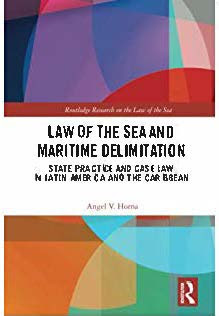
Horna: Law of the Sea and Maritime Delimitation: State Practice and Case Law in Latin America and the Caribbean
The law of maritime delimitation has been shaped by the interpretation of certain provisions of the United Nations Convention on the Law of the Sea, which has led to State practice being neglected in current scholarship. This book presents an overview of the under-examined question of the impact of State practice in Latin America and the Caribbean on the development of the law of maritime delimitation.
Examining the status of maritime boundaries in Latin America and the Caribbean, this book also ponders the impact of State practice and case law on the law of maritime delimitation. It outlines the historical framework of the establishment of maritime jurisdiction during colonial times and assesses the evolution of maritime delimitation and the contribution of Latin America and the Caribbean to the modern law of the sea. It discusses the law of maritime delimitation and, through jurisprudence, the development of the three-stage methodology to describe and explain maritime delimitation agreements in Latin America and the Caribbean according to the method or methods of delimitation employed. It reviews maritime boundaries in Latin America and the Caribbean that were submitted to third-party adjudication as well as provisional arrangements, considering the role of State practice in Latin America and the Caribbean on the development of the law of maritime delimitation.
New Issue: Journal of International Arbitration
The latest issue of the Journal of International Arbitration (Vol. 40, no. 3, 2023) is out. Contents include:- Gary B. Born & Sonya Ebermann, A New Patent Mediation and Arbitration Centre for Europe
- Therese Wilson, Yuri Banens, & Shanayah Sharif, ISDS and States’ Ability to Deal with Financial Crisis
- Kevin Ongenae, Electronic Arbitral Awards: Yea or Nay? A Glimpse Inside the Minds of Arbitral Institutions
- Orlando Federico Cabrera Colorado, The Future of International Arbitration in the Age of Artificial Intelligence
- Kenneth Ugwuokpe, Limitation Period for Enforcing Arbitral Awards in Nigeria: A Case of Justice Without Remedy