Exploring how international jurisprudence has catalysed the development of maritime delimitation law, this accessible book explores the ‘predominant interest’ concept and analyses global case studies, as well as landmark legal proceedings. Nicholas A. Ioannides provides a comprehensive overview of the delimitation process, identifying the criteria used to determine how maritime areas are delimited.
The book highlights how international courts and tribunals in delimitation cases have mainly relied on geographical factors, disregarding non-geographical elements, although they are at the core of the continental shelf and Exclusive Economic Zone concepts. Ultimately, Ioannides suggests that non-geographical factors should be taken into account in maritime delimitation in aggregation under the cloak of ''predominant interest'' in order to reach an equitable result. Highlighting how predictability should be safeguarded, and equitability should be enhanced, Ioannides outlines the importance of, among others, fishing, security, defence and navigation interests for individual states arguing for control over maritime zones.
Monday, June 2, 2025
Ioannides: The Predominant Interest Concept and Maritime Delimitation: Safeguarding Predictability and Enhancing Equitableness
Tuesday, July 25, 2023
Evans & Lewis: Islands, Law and Context: The Treatment of Islands in International Law
This ground-breaking book challenges legal orthodoxy, presenting an original approach to the treatment of islands in international law. It offers a new perspective on how to define islands in international law, questioning how they differ from other maritime features. It focuses on the contextual factors that bear upon the legal treatment of islands, recognising that, in practice, islands have varied and unequal impacts and arguing that greater focus on context is needed to understand legal outcomes, particularly those concerning maritime boundary delimitation. Addressing the impact of rising sea levels on the interests and rights of islands and the increasing construction of artificial islands, the authors make the case for a major change in approach to the topic.
Sunday, May 21, 2023
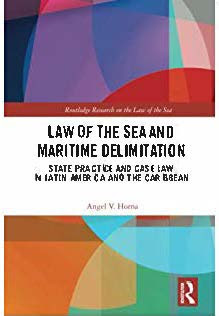
Horna: Law of the Sea and Maritime Delimitation: State Practice and Case Law in Latin America and the Caribbean
The law of maritime delimitation has been shaped by the interpretation of certain provisions of the United Nations Convention on the Law of the Sea, which has led to State practice being neglected in current scholarship. This book presents an overview of the under-examined question of the impact of State practice in Latin America and the Caribbean on the development of the law of maritime delimitation.
Examining the status of maritime boundaries in Latin America and the Caribbean, this book also ponders the impact of State practice and case law on the law of maritime delimitation. It outlines the historical framework of the establishment of maritime jurisdiction during colonial times and assesses the evolution of maritime delimitation and the contribution of Latin America and the Caribbean to the modern law of the sea. It discusses the law of maritime delimitation and, through jurisprudence, the development of the three-stage methodology to describe and explain maritime delimitation agreements in Latin America and the Caribbean according to the method or methods of delimitation employed. It reviews maritime boundaries in Latin America and the Caribbean that were submitted to third-party adjudication as well as provisional arrangements, considering the role of State practice in Latin America and the Caribbean on the development of the law of maritime delimitation.
Saturday, October 22, 2022
Ramnath: Making Maritime Boundaries in the Bay of Bengal
This essay explores the making of maritime boundaries in the Bay of Bengal in the northern Indian Ocean, emphasizing the role of visualizations in establishing states' jurisdictional claims to unstable coasts and ephemeral islands. These include colonial-era revenue surveys of the Sunderbans, sketches of land formation in the Godavari delta appended to case papers in litigations, nautical charts and inspection reports of the seabed in the Gulf of Mannar, maps drawn at the time of partitioning the subcontinent in South Asia and satellite imagery of the Bay's littoral. These visualizations are the everyday materials that delineate sea space in law, as judges, lawyers and states navigate fluidity and fixity, accuracy and equity in international law.
Thursday, October 20, 2022
Call for Papers: London International Boundary Conference
Thursday, December 30, 2021
Árnadóttir: Climate Change and Maritime Boundaries: Legal Consequences of Sea Level Rise
Coastal States exercise sovereignty and sovereign rights in maritime zones, measured from their coasts. The limits to these maritime zones are bound to recede as sea levels rise and coastlines are eroded. Furthermore, ocean acidification and ocean warming are increasingly threatening coastal ecosystems, which States are obligated to protect and manage sustainably. These changes, accelerating as the planet heats, prompt an urgent need to clarify and update the international law of maritime zones. This book explains how bilateral maritime boundaries are established, and how coastal instability and vulnerable ecosystems can affect the delimitation process through bilateral negotiations or judicial settlement. Árnadóttir engages with core concepts within public international law to address emerging issues, such as diminishing territory and changing boundaries. She proposes viable ways of addressing future challenges and sets out how fundamental changes to the marine environment can justify termination or revision of settled maritime boundaries and related agreements.
Wednesday, December 8, 2021
Schofield, Bekker, & van de Poll: The World Court Fixes the Somalia-Kenya Maritime Boundary: Technical Considerations and Legal Consequences
Tuesday, July 20, 2021
Pappa: Non-State Actors' Rights in Maritime Delimitation: Lessons from Land
Most of the world's maritime boundary disputes involve privately held rights - relating to such matters as fishing, petroleum exploration and scientific research - that states have unilaterally granted to non-state actors in areas of overlapping national claims. An international lawyer would typically investigate the legality of a state's decision to create such rights without notifying or consulting its neighbour, and the legal consequences this action would have for the interests of the states concerned. Departing from this approach, Dr Marianthi Pappa examines such situations from the perspective of the non-state actors: what will happen to private rights in a disputed maritime area if it changes hands from state A to state B due to a subsequent delimitation treaty or judgment? Does the legal framework of maritime delimitation protect those rights effectively against a potential reallocation? To address these questions, the book considers the place that private rights have in land boundary-making.
Wednesday, October 7, 2020
Ioannides: Maritime Claims and Boundary Delimitation: Tensions and Trends in the Eastern Mediterranean Sea
This book delves into the major developments triggered by the hydrocarbon discoveries in the Eastern Mediterranean over the last twenty years, focusing on maritime boundary delimitation.
Examining the impact that the hydrocarbon discoveries have had on the application of the law of the sea rules by the East Med states, the book looks at the new trends concerning the implementation of the law of the sea in the region. The book analyses regional state practice in terms of maritime delimitation, namely the conclusion of bilateral agreements based on the law of the sea rules, both conventional and customary, reflecting the East Med states’ willingness to cooperate in order to reap the benefits of the energy windfall. Alongside this analysis, an outline of the hydrocarbon discoveries and the pertinent maritime activities is given, as well as further coverage of the overlapping maritime claims and disputes between Greece, Cyprus and Turkey on one side, and Lebanon and Israel on the other. Moreover, the book examines the validity of maritime claims made by or through non-state entities in the region, namely the State of Palestine, the UK Sovereign Base Areas and the so-called ‘Turkish Republic of Northern Cyprus’ and their potential impact on the delimitation agreements already in place. The book argues that the East Med paradigm concerning the successful application of the pertinent norms in maritime delimitation proves that international law is resilient and capable of providing solutions in other turbulent regions around the globe.
Monday, June 22, 2020
Palestini: La protection des intérêts juridiques de l'État tiers dans le procès de délimitation maritime
Qui dit État tiers au procès de délimitation maritime, dit avant tout risque d’empiéter sur les espaces susceptibles d’appartenir à ce dernier. L’empiétement se produit lorsque, avant d’atteindre l’extrémité de la délimitation retenue par les juges ou arbitres, ce sont les espaces maritimes d’un État tiers, et non plus ceux des Parties au procès, qui risquent d’être présents de part et d’autre de la ligne.
Dans la mesure où tout État côtier peut, entre autres, revendiquer des espaces maritimes situés jusqu’à 200 milles marins de son littoral, tels que la zone économique exclusive et le plateau continental, il en découle que bien souvent trois, voire quatre, projections côtières finissent par se superposer sur un seul et unique espace maritime.
Ce chevauchement de titres, à l’origine d’une pluralité de différends, engendre le risque d’empiétement, mais aussi d’autres difficultés aux stades, par exemple, de l’identi fication de la zone pertinente aux fins de délimiter et de la vérification de l’absence de disproportion marquée entre les espaces attribués à chacune des Parties à la procédure. Assurément, en présence de tiers, le procès de délimitation maritime est un sentier semé d’embûches où le risque de commettre un faux pas est particulièrement tangible.
Si les conflits en mer de Chine méridionale et dans l’Arctique témoignent de l’actualité du sujet, il convient de souligner que cette problématique survient dans tous les océans et mers du monde. L’importance du sujet ne peut d’ailleurs que croître à l’avenir car ce sont justement les différends maritimes impliquant plus que deux États qui ont tendance à se perpétuer dans le temps.
L’ouvrage met en lumière une attitude au demeurant contradictoire. D’un côté, la jurisprudence se montre favorable à la prise en considération des intérêts des États tiers. Cela témoigne de la reconnaissance du fait que le principe de la relativité de la chose jugée offre une protection tout compte fait insuffisante aux tiers. D’un autre côté, cependant, la Cour internationale de Justice adopte une approche trop restrictive en matière d’intervention. Ceci atteste d’une politique judiciaire qui s’enferme dans une logique bilatérale à notre sens déplacée et contreproductive.
Thursday, January 9, 2020
Tanaka: Predictability and Flexibility in the Law of Maritime Delimitation
This fully revised new edition offers a comprehensive picture of the law of maritime delimitation, incorporating all new cases and State practice in this field. As with all types of law, the law of maritime delimitation should possess a degree of predictability. On the other hand, as maritime delimitation cases differ, flexible considerations of geographical and non-geographical factors are also required in order to achieve equitable results. How, then, is it possible to ensure predictability while taking into account a number of diverse factors in order to achieve an equitable result? This is the question at the heart of the law of maritime delimitation. This book explores a well-balanced legal framework that reconciles predictability and flexibility in the law of maritime delimitation by looking at three aspects of the question: first it reviews the evolution of the law of maritime delimitation; second, it undertakes a comparative study of the case law and State practice; and third, it critically assesses the law of maritime delimitation in its current form.
Thursday, June 6, 2019
Lando: Maritime Delimitation as a Judicial Process
Maritime Delimitation as a Judicial Process is the first comprehensive analysis of judicial decisions, state practice and academic opinions on maritime boundary delimitation. For ease of reading and clarity, it follows this three-stage approach in its structure. Massimo Lando analyses the interaction between international tribunals and states in the development of the delimitation process, in order to explain rationally how a judicially-created approach to delimit maritime boundaries has been accepted by states. Pursuing a practical approach, this book identifies disputed points in maritime delimitation and proposes solutions which could be applied in future judicial disputes. In addition, the book engages with the underlying theories of maritime delimitation, including the relationship between delimitation and delineation, the effect of third states' rights on delimitation, and the manner in which each stage of the process influences the other stages.
Tuesday, June 4, 2019
Yiallourides: Maritime Disputes and International Law: Disputed Waters and Seabed Resources in Asia and Europe
The settlement of the maritime boundary disputes between China and Japan in the East China Sea, and between Greece and Turkey in the Aegean Sea, is politically deadlocked. While diplomatic settlement efforts have been ongoing for the past several decades, neither side in each case appears prepared to back down from its respective maritime and territorial claims. Several incidents at sea have occurred, prompting diplomatic protests, military standoffs, even exchange of fire. The existing status quo is inherently unstable and does not favour either side to the extent that it holds hostage the multiple benefits that could otherwise be generated from the exploitation of the seabed energy and mineral resources in the disputed waters, creating an urgent need for a meaningful discussion on finding a practical way forward. This monograph undertakes a comprehensive analysis of these disputes based on the rules and principles of international law, critically evaluating possible institutional designs of inter-State cooperation over seabed activities in disputed maritime areas and makes recommendations for the prospect of realising joint development regimes in the East China Sea and the Aegean to coordinate the exploration for and exploitation of resources without having resorted previously to boundary delimitation settlement.
Tuesday, February 26, 2019
Blitza: Auswirkungen des Meeresspiegelanstiegs auf maritime Grenzen
Das Buch geht der Frage nach, ob und inwiefern sich meeresspiegelinduzierte Veränderungen der Küstenlinien auch im Verlauf maritimer Grenzen widerspiegeln. Nach Untersuchung der maßgeblichen Vorschriften des Seerechtsübereinkommens (SRÜ) kommt die Arbeit zu dem Ergebnis, dass Veränderungen des Küstenverlaufs Auswirkungen auf maritime Grenzen haben können, das Ausmaß der Veränderung allerdings von der konkreten Art der Grenze und deren Entfernung zur Basislinie abhängt. Global betrachtet birgt die Beweglichkeit der Seegrenzen ein erhöhtes Konfliktpotential, denn sie wird Unsicherheit über bestehende Grenzverläufe verursachen. Seegrenzen sollten daher dauerhaft stabilisiert werden. Der Autor belegt, dass dies auf Grundlage des geltenden Rechts nicht sinnvoll gelingen wird. Nur durch Änderung des SRÜ oder der Herausbildung von neuem Völkergewohnheitsrecht ließe sich verhindern, dass das internationale Seerecht die Folgen des durch den Meeresspiegelanstieg bedingten Landverlusts nicht noch verschlimmert.
Monday, April 16, 2018
Oude Elferink, Henriksen, & Busch: Maritime Boundary Delimitation: The Case Law - Is It Consistent and Predictable?
- Alex G. Oude Elferink, Tore Henriksen, & Signe Veierud Busch, The Judiciary and the Law of Maritime Delimitation: Setting the Stage
- Davor Vidas, The Delimitation of the Territorial Sea, the Continental Shelf, and the EEZ: A Comparative Perspective
- Nuno Marques Antunes & Vasco Becker-Weinberg, Entitlement to Maritime Zones and Their Delimitation: In the Doldrums of Uncertainty and Unpredictability
- Donald McRae, The Applicable Law: The Geneva Convention on the Continental Shelf, the LOSC, and Customary International Law
- Natalie Klein, Provisional Measures and Provisional Arrangements
- Lucie Delabie, The Role of Equity, Equitable Principles, and the Equitable Solution in Maritime Delimitation
- Alex G. Oude Elferink, Relevant Coasts and Relevant Area: The Difficulty of Developing General Concepts in a Case-Specific Context
- Coalter G. Lathrop, The Provisional Equidistance Line: Charting a Course between Objectivity and Subjectivity?
- Malcolm Evans, Relevant Circumstances
- Naomi Burke O’Sullivan, The Case Law’s Handling of Issues Concerning Third States
- Yoshifumi Tanaka, The Disproportionality Test in the Law of Maritime Delimitation
- Signe Veierud Busch, The Delimitation of the Continental Shelf beyond 200 nm: Procedural Issues
- Øystein Jensen, The Delimitation of the Continental Shelf beyond 200 nm: Substantive Issues
- Alex G. Oude Elferink, Tore Henriksen, & Signe Veierud Busch, Conclusions: Taking Stock and Looking Ahead
Friday, October 13, 2017
Bekker & van de Poll: Ghana and Côte d’Ivoire Receive a Strict-Equidistance Boundary
Wednesday, March 1, 2017
Kambale Isemughole: Délimitation maritime entre la RD Congo et l'Angola
Pour garantir l'équité des solutions juridiques ou politiques afférentes aux contentieux de délimitation des frontières, il importe qu'il y ait une parfaite adéquation entre le règlement des différends prévus par le droit international et le contexte tant politique, économique, géographique qu'historique. Le règlement diplomatique du différend de délimitation maritime entre la RDC et l'Angola sur la côte Atlantique ne peut pas présager d'une solution équitable garantissant des droits légitimes d'extension en mer d'un Etat côtier géographiquement désavantagé comme la RDC. Voici est un plaidoyer pour un règlement de ce différend devant la Cour pénale internationale de justice.
Tuesday, June 7, 2016
Whomersley: The South China Sea: The Award of the Tribunal in the Case Brought by Philippines against China—A Critique
The Tribunal in the case brought by the Philippines against China in relation to the South China Sea has recently given its decision on whether it has jurisdiction to entertain the claims. Although it only found unequivocally that it has jurisdiction over three of the fifteen claims, this paper explains why in a number of respects the argumentation used by the Tribunal is weak. In particular it questions whether the Tribunal was right to proceed when issues of maritime delimitation and disputes over territorial sovereignty are outside its jurisdiction. The paper also criticizes the manner in which the Tribunal reached the conclusion that there was no undertaking to solve any disputes in the South China Sea through other means.
Monday, May 30, 2016
SFDI: Droit des frontières internationales
Tous les deux ans, la Société française pour le droit international (SFDI) et Deutsche Gesellschaft für Internationales Recht (DGIR) tiennent un colloque conjoint. Les journées conjointes de 2014 ont eu lieu en Belgique, à l’Université de Louvain (UCL), sur le thème du « Droit des frontières internationales ». Bien qu’il s’agisse d’une thématique classique en droit international public, sinon fondatrice de la discipline, elle présente un intérêt renouvelé à l’heure de la globalisation et mérite une réappropriation contemporaine. L’explosion du contentieux de la délimitation maritime, le tracé de nouvelles frontières en Afrique à la suite de l’émergence de nouveaux Etats (Erythrée, Sud Soudan), la multiplication de situations territoriales controversées (Abkhazie, Ossétie du Sud, Kosovo, Transnistrie, Haut Karabakh, Crimée…), la consolidation de zones contrôlées par des groupes non-étatiques (EIIL), l’émergence d’un régime d’application extraterritoriale des droits de l’homme, les questions migratoires, l’impact des délimitations territoriales sur le droit des investissements, et, enfin, la transformation profonde de la signification des frontières au sein de l’Union européenne – autant de questions qui justifient une réflexion d’ensemble sur le droit des frontières internationales et qui ont été abordées au cours de ces journées conjointes.
Thursday, March 24, 2016
Fietta & Cleverly: A Practitioner's Guide to Maritime Boundary Delimitation
This book provides a user-friendly and practical guide to the modern law of maritime boundary delimitation. The law of maritime boundaries has seen substantial evolution in recent decades. The book provides a comprehensive overview of the law in this field, and its development through the United Nations Convention on the Law of the Sea, which set out the framework of the modern law in 1982. The Convention itself has since been substantially built upon and clarified by a series of judicial and arbitral decisions in boundary disputes between sovereign states, which themselves also built upon earlier case law. The book dissects each of the leading international judgments and awards since the North Sea Continental Shelf Cases in 1969, providing a full analysis of the issues and context in each case, explaining their fundamental importance to shaping the law.
The book provides over forty clear technical illustrations prepared by Robin Cleverly, one of the leading technical experts in international dispute resolution, to carefully demonstrate the key issues at stake in this complex area of law. Technological developments in the exploitation of maritime natural resources (including oil and gas) have provided a significant impetus for recent boundary disputes, as they have made the resources found in remote areas of the ocean and seabed more accessible. However, these resources cannot effectively be exploited at the moment, as hundreds of maritime boundaries worldwide remain undelimited. The book therefore complements the legal considerations raised with substantial technical input. It also identifies key issues in maritime delimitation which have yet to be resolved, and sets out the possible future direction the law may take in resolving them. It will be an unique and valuable resource for lawyers involved in cases involving maritime delimitation, and scholars and students of the law of the sea.