Exploring the relationship and interaction between economic interests and normative non-trade values, this book argues that the emergence and development of non-trade values is based on a complex dialectic interaction between selfish economic interests and normative values, and examines how their structural interdependence has given rise to a remarkable evolution in international trade. Conceiving this relationship as an intricate dialectic one that is neither purely value-driven, nor purely economic-interest-driven, it addresses the emergence, function, and role of non-trade values in international trade with a synthetizing approach and explores the results of their interaction in international economic intercourse. Approaching the non-trade issues of trade in a holistic manner, the book demonstrates that trade can operate smoothly only if it is framed by an architecture of normative value standards and international trade liberalization has reached the level where further development calls for cooperation also in fields that, at first glance, may appear to be non-trade in nature.
Friday, December 31, 2021
Nagy: Global Values and International Trade Law
Call for Papers: International Economic Law and New Frontiers of Global Security
Call for Papers: Regulating Global Security: History of an Illusion
Thursday, December 30, 2021
New Issue: Vereinte Nationen
- Schwerpunkt: Zeit für ein besseres Klima
- Jan Burck & Thea Uhlich, Neue Energie für den Klimaschutz
- Drei Fragen an Christiane Textor
- Carl-Friedrich Schleußner, Standpunkt | Die Bedeutung des IPCC-Berichts für die COP-26
- Reiner Klingholz, Immer mehr Menschen wollen immer mehr
- Lisa Reggentin, Klimawandel als Konflikttreiber in Nigeria
- Hermann E. Ott & Lea Main-Klingst, Klagen gegen den Klimawandel
- Im Diskurs
- Imke Steimann, Die Kinder des Islamischen Staates
New Issue: World Politics
The latest issue of World Politics (Vol. 73, no. 4, October 2021) is out. Contents include:- Alexander de Juan, Felix Haass, & Jan Pierskalla, The Partial Effectiveness of Indoctrination in Autocracies: Evidence from the German Democratic Republic
- Filip Kostelka & André Blais, The Generational and Institutional Sources of the Global Decline in Voter Turnout
- Amy Catalinac & Lucia Motolinia, Geographically Targeted Spending in Mixed-Member Majoritarian Electoral Systems
- Edgar Franco-Vivanco, Justice as Checks and Balances: Indigenous Claims in the Courts of Colonial Mexico
- Sungmin Cho, Why Non-Democracy Engages with Western Democracy-Promotion Programs: The China Model
New Issue: Revista Iberoamericana de Derecho Internacional y de la Integración
Moynihan: Transboundary Freshwater Ecosystems in International Law: The Role and Impact of the UNECE Environmental Regime
A global water crisis with far-reaching and interconnected environmental, social, health and economic impacts threatens the world. Healthy ecosystems and ecosystem services are degrading, and access to a sustainable water supply is increasingly inequitable both within and between States. This book demonstrates how to overcome the global freshwater ecosystem crisis by matching the scientific recommendations with an international legal framework fit for the task, which re-orientates international water law towards a stronger ecosystem approach that also protects vulnerable societies. It illustrates how to understand the fragmented legally binding and non-binding instruments of the United Nations Economic Commission for Europe environmental treaties as one coherent legal regime, which contributes to strengthening general rules and principles of the law concerning transboundary freshwater ecosystems. With the recent global opening of the UNECE regime, this book explores its potential role within the European region, Central Asia, Caucasus, Africa, the Middle East and beyond.
van Doore: Orphanage Trafficking in International Law
Orphanage Trafficking in International Law explores the process of orphanage trafficking as a form of child trafficking in international law, examining the contexts in which it occurs and providing a comprehensive, holistic approach to addressing the issue as a form of trafficking. In doing so, this book establishes the method and process of orphanage trafficking as an issue of international concern. It reconceptualises the activity of orphanage tourism as a demand driver for child trafficking and a form of exploitation, and makes recommendations for how countries where orphanage trafficking occurs, as well as countries that contribute to orphanage trafficking via funding and volunteers, should tackle the issue.
Árnadóttir: Climate Change and Maritime Boundaries: Legal Consequences of Sea Level Rise
Coastal States exercise sovereignty and sovereign rights in maritime zones, measured from their coasts. The limits to these maritime zones are bound to recede as sea levels rise and coastlines are eroded. Furthermore, ocean acidification and ocean warming are increasingly threatening coastal ecosystems, which States are obligated to protect and manage sustainably. These changes, accelerating as the planet heats, prompt an urgent need to clarify and update the international law of maritime zones. This book explains how bilateral maritime boundaries are established, and how coastal instability and vulnerable ecosystems can affect the delimitation process through bilateral negotiations or judicial settlement. Árnadóttir engages with core concepts within public international law to address emerging issues, such as diminishing territory and changing boundaries. She proposes viable ways of addressing future challenges and sets out how fundamental changes to the marine environment can justify termination or revision of settled maritime boundaries and related agreements.
Boer: International Law As We Know It: Cyberwar Discourse and the Construction of Knowledge in International Legal Scholarship
International legal scholars tend to think of their work as the interpretation of rules: the application of a law 'out there' to concrete situations. This book takes a different approach to that scholarship: it views doctrine as a socio-linguistic practice. In other words, this book views legal scholars not as law-appliers, but as constructing knowledge within a particular academic discipline. By means of three close-ups of the discourse on cyberwar and international law, this book shows how international legal knowledge is constructed in ways usually overlooked: by means of footnotes, for example, or conference presentations. In so doing, this book aims to present a new way of seeing international legal scholarship: one that pays attention to the mundane parts of international legal texts and provides a different understanding of how international law as we know it comes about.
Huerta-Goldman & Gantz: The Comprehensive and Progressive Trans-Pacific Partnership: Analysis and Commentary
The Comprehensive and Progressive Agreement for Trans-Pacific Partnership among eleven key nations of the Pacific Rim has already expanded trade and economic cooperation among the Parties. It also serves to encourage political cooperation among them and has served as a model for future 'wide and deep' free trade agreements. The chapters of this book will provide readers with a detailed understanding of the CPTPP's coverage, including provisions relating to tariff elimination, customs rules of origin, agriculture, sanitary and phytosanitary measures, technical barriers to trade, telecommunications, intellectual property, investment and investor–state arbitration, financial and other services, government procurement, state-owned enterprises, electronic commerce and digital trade, small and medium-sized enterprises, competition law, labor and environmental protection, dispute settlement, and many others. No international lawyer, economist, trade negotiator, or enterprise can afford not to take advantage of the opportunities for business that the CPTPP offers. This book has been written by CPTPP negotiators, experts, and practitioners.
Jevglevskaja: International Law and Weapons Review: Emerging Military Technology under the Law of Armed Conflict
International law requires that, before any new weapon is developed, purchased or modified, the legality of its use must be determined. This book offers the first comprehensive and systemic analysis of the law mandating such assessments – Article 36 of the 1977 Additional Protocol I to the Geneva Conventions. Underpinned by empirical research, the book explores the challenges the weapons review authorities are facing when examining emerging military technology, such as autonomous weapons systems and (autonomous) cyber capabilities. It argues that Article 36 is sufficiently broad to cover a wide range of military systems and offers States the necessary flexibility to adopt a process that best suits their organisational demands. While sending a clear signal that law should not simply follow technological developments, but rather steer them, the provision has its limits, however, which are shaped and defined by the interpretative decisions made by States.
New Issue: Questions of International Law
- The shadow pandemic: Assessing the impact of COVID-19 on women’s rights
- Introduced by Micaela Frulli
- Enzamaria Tramontana, Women’s rights and gender equality during the COVID-19 pandemic
- Deborah Russo, Gender equality in the context of recovery plans after the Covid-19 pandemic
Wednesday, December 29, 2021
Gibney, Erdem Türkelli, Krajewski, & Vandenhole: The Routledge Handbook on Extraterritorial Human Rights Obligations
The Routledge Handbook on Extraterritorial Human Rights Obligations brings international scholarship on transnational human rights obligations into a comprehensive and wide-ranging volume. Each chapter combines a thorough analysis of a particular issue area and provides a forward-looking perspective of how extraterritorial human rights obligations (ETOs) might come to be more fully recognized, outlining shortcomings but also best state practices. It builds insights gained from state practice to identify gaps in the literature and points to future avenues of inquiry. The Handbook is organized into seven thematic parts: conceptualization and theoretical foundations; enforcement; migration and refugee protection; financial assistance and sanctions; finance, investment and trade; peace and security; and environment. Chapters summarize the cutting edge of current knowledge on key topics as leading experts critically reflect on ETOs, and, where appropriate, engage with the Maastricht Principles to critically evaluate their value 10 years after their adoption.
New Issue: Pécs Journal of International and European Law
- Bence Kis Kelemen, Quo vadis ECtHR? An assessment of Carter v. Russia before the European Court of Human Rights (Editorial comments)
- Brian Drummond, UK Nuclear Deterrence Policy and International Law: Terrorism with Impunity?
- Lilla Ozoráková, The right to a fair trial at international criminal courts and tribunals – Are the standards of international criminal proceedings fair enough?
- Anna Réka Szerencsés, The Protection of Fundamental Rights in the Jurisprudence of the CJEU and the Charter –Twelve Years On
- Valéria Horváth, Haitians in limbo – Legal responses for migration induced by the 2010 Haitian earthquake on the American continent
- Csongor István Nagy, EU Private International Law in Family and Succession Matters: The Hungarian Judicial Practice
- Mirabella Nezdei & Peter H. Koehn, Transnational Mobility and Global Health. Traversing Borders and Boundaries
Tuesday, December 28, 2021
Palmer, Bikundo, Harris Rimmer, & Clark: Futures of International Criminal Justice
This collection identifies and discusses problems and opportunities for the theory and practice of international criminal justice. The International Criminal Court and project of prosecuting international atrocity crimes have faced multiple challenges and critiques. In recent times, these have included changes in technology, the conduct of armed conflict, the environment, and geopolitics. The mostly emerging contributors to this collection draw on diverse socio-legal research frameworks to discuss proposals for the futures of international criminal justice. These include addressing accountability gaps and under-examined or emerging areas of criminality at, but also beyond, the International Criminal Court, especially related to technology and the environment. The book discusses the tensions between universalism and localisation, as well as the regionalisation of international criminal justice and how these approaches might adapt to dynamic organisational, political and social structures, at the ICC and beyond.
Tsagourias & Buchan: Research Handbook on International Law and Cyberspace (2nd ed.)
This revised and expanded edition of the Research Handbook on International Law and Cyberspace brings together leading scholars and practitioners to examine how international legal rules, concepts and principles apply to cyberspace and the activities occurring within it. In doing so, contributors highlight the difficulties in applying international law to cyberspace, assess the regulatory efficacy of these rules and, where necessary, suggest adjustments and revisions.
More specifically, contributors explore the application of general concepts and principles to cyberspace such as those of sovereignty, power, norms, non-intervention, jurisdiction, State responsibility, human rights, individual criminal responsibility and international investment law and arbitration. Contributors also examine how international law applies to cyber terrorism, cyber espionage, cyber crime, cyber attacks and cyber war as well as the meaning of cyber operations, cyber deterrence and the ethics of cyber operations. In addition, contributors consider how international and regional institutions such as the United Nations, the European Union, NATO and Asia-Pacific institutions and States such as China and Russia approach cyber security and regulation.
New Issue: International Journal of Refugee Law
The latest issue of the International Journal of Refugee Law (Vol. 33, no. 2, June 2021) is out. Contents include:- Special Issue on the 70th Anniversary of the 1951 Refugee Convention: Part 1
- Maja Janmyr, The 1951 Refugee Convention and Non-Signatory States: Charting a Research Agenda
- Sébastien Moretti, Southeast Asia and the 1951 Convention relating to the Status of Refugees: Substance without Form?
- Ciara Smyth, The Human Rights Approach to ‘Persecution’ and Its Child Rights Discontents
- Adel-Naim Reyhani, Anomaly upon Anomaly: The 1951 Convention and State Disintegration
- Eric Fripp, Nationality, Protection, and ‘the Country of His Nationality’ as the Country of Reference for the Purposes of Article 1A(2) of the 1951 Convention relating to the Status of Refugees
Monday, December 27, 2021
Young: Supplying Compliance with Trade Rules: Explaining the EU's Responses to Adverse WTO Rulings
Trade agreements have become politicized in part because of public concerns that trade rules constrain regulatory decisions. How much international obligations constrain state behaviour, however, is contested in the International Relations literature. This book seeks to explain whether, why, and how jurisdictions comply with inconvenient international obligations. It does so through detailed process tracing of European Union (EU) policies found incompatible with World Trade Organization (WTO) rules: its ban on hormone-treated beef, its banana trade regime, its moratorium on the approval of genetically modified crops, its sugar export subsidies, and its anti-dumping duties on bed linen from India. It uses the adverse rulings as the 'treatment' in a 'natural experiment', contrasting the policy-relevant politics before and after each ruling. The case studies are supplemented by a qualitative comparative analysis of all EU policies found to contravene WTO rules that had to be changed by the end of 2019. The book contributes to debates on the impact of international institutions, on the effectiveness of the WTO, and on the nature of the EU as an international actor. It argues that the preferences of policy makers (the 'supply' of policy change) matter more than demands from societal actors in determining whether compliance occurs. It also argues that while policy change in response to adverse WTO rulings is the norm (good news for trade), WTO members do resist obligations that would compromise cherished policy objectives (good news for legitimacy). This volume contends that the EU's compliance performance is like that of most WTO members; it is not a unique international actor.
Leinarte: Functional Responsibility of International Organisations: The European Union and International Economic Law
This book provides a novel approach to the allocation of international responsibility in a multilayered structure like the European Union. Introducing a new concept of functional international responsibility, this study finds that in international economic law the focus of international dispute settlement bodies is not on the responsible party, but on a party best placed to bear responsibility. The book offers a comprehensive analysis of international rules of responsibility and international dispute settlement practice, primarily that of the World Trade Organization and investment arbitration. The study offers a practically applicable approach to questions of international responsibility which will assist international adjudicators, EU and Member States' officials and third country government agents who negotiate economic agreements and are involved in international economic disputes. The book is also relevant to those interested in the governance and accountability questions under the new EU-UK Trade and Cooperation Agreement.
Chiam: International Law in Public Debate
Public debates in the language of international law have occurred across the 20th and 21st centuries and have produced a popular form of international law that matters for international practice. This book analyses the people who used international law and how they used it in debates over Australia's participation in the 2003 Iraq War, the Vietnam War and the First World War. It examines texts such as newspapers, parliamentary debates, public protests and other expressions of public opinion. It argues that these interventions produced a form of international law that shares a vocabulary and grammar with the expert forms of that language and distinct competences in order to be persuasive. This longer history also illustrates a move from the use of international legal language as part of collective justifications to the use of international law as an autonomous justification for state action.
Conference: Teaching Migration and Asylum Law and Policy
Sunday, December 26, 2021
Discussion Group: Tladi on “The Second Reading of the ILC's Draft Conclusions on Peremptory Norms”
Saturday, December 25, 2021
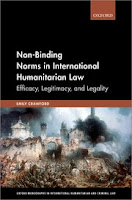
Crawford: Non-Binding Norms in International Humanitarian Law: Efficacy, Legitimacy, and Legality
This monograph examines and analyses the phenomenon of non-binding instruments (also known as 'soft law') in the law of armed conflict, or international humanitarian law.
In the past 30 years, there have been several non-binding instruments created, designed as either 'best practice' guidelines, or (re)statements of applicable law. These instruments are not treaties, but they nevertheless put themselves forward as authoritative statements of what the law is and, in some instances, what the law should be. Soft law instruments can be dynamic, prompt, and responsive measures to address pressing issues in armed conflicts. By drawing on the skill of a small group of experts, these instruments can be debated and drafted in a timelier manner than if these issues were to be left to the international community of 194 States to resolve. Furthermore, because these instruments do not have to be sent for debate to an international conference of States, it means that the provisions are not subject to the usual revisions, reservations, and dilutions that come with attempting to reach consensus. However, there are potential and actual problems with these instruments and the processes that bring them to fruition, and how they are received in practice by States and other stakeholders.
This volume looks at the benefits and drawbacks for States and non-State actors with regards to soft law, whether they are effective additions to the law of armed conflict, analysing the development through the lens of theories of legitimacy and legality in international law.
Iurlaro: The Invention of Custom: Natural Law and the Law of Nations, ca. 1550-1750
The concept of customary international law, although differently formulated, is already present in early modern European debates on natural law and the law of nations. However, no scholarly monograph has, until now, addressed the relationship between custom and the European natural law and ius gentium tradition. This book tells that neglected story, and offers a solid conceptual framework to contextualize and understand the 'problematic of custom', namely how to identify its normative content. Natural law doctrines, and the different ways in which they help construct human reason, provided custom with such normative content. This normative content consists of a set of fundamental moral values that help identify the status of custom as either a fundamental feature or an original source of ius gentium. This book explores what cultural values and practices facilitated the emergence of custom and rendered it into as a source of the law of nations, and how they did so. Two crucial issues form the core of the book's analysis. Firstly, it qualifies the nature of the interrelation between natural law and ius gentium, explaining why it matters in relation to our understanding of the idea of custom. Second, the book claims that the process of custom formation as a source of law calls into question the role of the authority of history. The interpretation of the past through this approach can thus be described as one of 'invention'.