How does international law entitle individuals to challenge violations of international law before domestic courts? Developing the novel concept of access rights, Leander Beinlich takes a thorough look at the domestic adjudication of international law through the lens of individual rights.
Beinlich provides an in-depth survey of the main access rights: the right to a remedy and the right of access to a court. In an unprecedented analysis, he applies his findings to cases of external state action such as military operations abroad, a domain traditionally characterized by accountability gaps. Access to Domestic Justice for Violations of International Law presents crucial insights into the value, risks and limitations of individual rights at the intersection of international law and foreign relations law. It demonstrates how access rights put to a test the doctrinal hurdles and normative concerns impeding access to justice in this area, paving the way for further research.
Wednesday, September 3, 2025
Beinlich: Access to Domestic Justice for Violations of International Law: Seeking Accountability for External State Action
Sunday, October 13, 2024
Bradley: Historical Gloss and Foreign Affairs: Constitutional Authority in Practice
In the more than 230 years since the Constitution took effect, the constitutional law governing the conduct of foreign affairs has evolved significantly. But that evolution did not come through formal amendments or Supreme Court rulings. Rather, the law has been defined by the practices of Congress and the executive branch, also known as “historical gloss.”
Curtis A. Bradley documents this process in action. He shows that expansions in presidential power over foreign affairs have often been justified by reference to historical gloss, but that Congress has not merely stepped aside. Belying conventional accounts of the “imperial presidency” in foreign affairs, Congress has also benefited from gloss, claiming powers for itself in the international arena not clearly addressed in the constitutional text and disrupting claims of exclusive presidential authority.
Historical Gloss and Foreign Affairs proposes a constitutional theory that can make sense of these legal changes. In contrast, originalist theories of constitutional interpretation often ignore influential post-Founding developments, while nonoriginalist theories tend to focus on judicial decisions rather than the actions and reasoning of Congress and the executive branch. Moreover, the constitutional theories that do focus on practice have typically emphasized changes at particular moments in time. What we see in the constitutional law of foreign affairs, however, is the long-term accumulation of nonjudicial precedents that is characteristic of historical gloss. With gloss confirmed as a prime mover in the development of foreign affairs law, we can begin to recognize its broader status as an important and longstanding form of constitutional reasoning.
Thursday, July 4, 2024
Nollkaemper, Shany, & Tzanakopoulos: The Engagement of Domestic Courts with International Law: Comparative Perspectives
The relationship between domestic courts and international law is usually defined by the frameworks of monism and dualism. The Engagement of Domestic Courts with International Law advances and develops a new paradigm for describing, assessing, and understanding the role of domestic courts in the international legal order.
Two trends are examined in parallel in this volume. The traditional dividing lines between national and international law norms and institutions have become increasingly blurred. However, the practice of domestic courts can less and less be understood by reference to a formal approach that dictates how national legal orders receive international law. The solutions that courts reach are often based on a variety of other considerations that are not captured by the classical formal models. The aim of the book is to bring together the wide variety of types of engagement, as an important step towards a better understanding of what courts do and, eventually, towards a normative exercise of articulating principles or guidelines for the engagement of domestic courts with international law.
To bring together the pragmatic approaches of domestic courts, the International Law Association Study Group on Principles on the Engagement of Domestic Courts with International Law engaged in studies with experts from a variety of backgrounds. On the basis of the Study Group's Final Report, the editors of this book continued to work with experts from different jurisdictions to collect and analyse alternate pragmatic forms of engagement from domestic courts. This publication contains the outcome of this process.
Thursday, May 23, 2024
Contesse: The American Convention on Human Rights in Latin American National Courts
This Chapter addresses the role that Latin America’s major human rights treaty—the American Convention on Human Rights, adopted in 1969, with the Inter-American Court as its main interpreter—plays in constitutional interpretation conducted by national courts. The Chapter proceeds as follows: in Part II, I describe domestic constitutional law in Latin America, focusing on both national constitutions and decisions by Latin American courts. I show that the trend, since at least the late 1980s, is one of great interdependence between domestic and international law. Consequently, international law is a key interpretive guideline to domestic courts. In Part III, I discuss the Court’s main functions—contentious, advisory and monitoring—and explain how the Court has increasingly become a crucial tool for domestic constitutional interpretation. I use the anti-impunity doctrine and the articulation of the conventionality control doctrine as key examples of this trend. In this Part, I also use the same-sex marriage advisory opinion as an instance of robust interaction between the domestic and international realms. Finally, I turn to instances of domestic judicial implementation of the Court’s judgments as another example of the Court’s influence on national courts as a constitutional interpreter.
Sunday, May 5, 2024
Call for Papers: Between crisification and legal resilience: Change and stability in EU external relations law
Thursday, April 25, 2024
Call for Papers: General principles in EU external relations law
Wednesday, March 20, 2024
Lange: Treaties in Parliaments and Courts: The Two Other Voices
Highlighting the close relationship between foreign relations law and international law, this impressive book places parliament and domestic courts’ engagement with treaties at the heart of its inquiry. It presents a timely assessment of the impact that different rules of constitutional law have on parliamentary and judicial approaches to treaties in four different states (Germany, India, South Africa and the US), thereby incorporating valuable comparative dimensions.
With intellectual rigour, Felix Lange demonstrates how diverse conceptions of foreign relations law affect whether parliaments act as promoters, shapers or translators of human rights treaties, the Rome Statute to the International Criminal Court, and climate change treaties. Lange not only analyses the ways in which domestic courts rely on treaties through consistent interpretation and direct application, but also how they may dismiss treaty provisions as non-self-executing or employ the concept of non-justiciability in matters of foreign affairs. Ultimately, Lange embraces the view that parliaments and courts are being increasingly heard and suggests that their voices should become even louder.
Saturday, November 25, 2023
Orakhelashvili: From “dualism” towards isolationism? Or why the Government keeps losing cases
Thursday, November 23, 2023
Call for Papers: Comparative International Legal Policy: National Political Approaches Towards International Legal Order
Sunday, September 24, 2023
Galbraith: Derivative Foreign Relations Law
We treat U.S. foreign relations law as a discrete body of law—and it is. But it is not independent. To the contrary, it relies on the same institutional actors that govern more generally: the President, Congress, the federal judiciary, administrative agencies, and sub-national governments. And far from being static, these institutions change radically over time in how they are constituted, in what internal rules they apply, and in what legal outputs they produce. The Trump Administration is a recent and painful example whose legacy continues to loom large, including on the Supreme Court. This symposium contribution considers what these broader institutional changes mean for foreign relations law.
Monday, September 11, 2023
Symposium: The Statutory Foreign Affairs Presidency
Sunday, August 13, 2023
Eichensehr & Hathaway: Major Questions about International Agreements
The Supreme Court’s recent expansion of the major questions doctrine has rocked administrative law, throwing into doubt executive agencies’ statutory authority for numerous regulations. Some justices have suggested that they want to go further and reinvigorate the non-delegation doctrine as a constitutional limit on Congress’s authority to delegate power to the executive branch. This Article is the first to consider how these developments might put at risk the United States’ international commitments.
The Article first identifies the role of congressional delegations to the executive branch with respect to the formation and implementation of ex ante congressional-executive agreements, executive agreements pursuant to treaties, sole executive agreements, and non-binding agreements, and it explains how the Supreme Court’s recent decisions might spark challenges to the agreements themselves or to the executive’s authority to implement them.
Turning from the diagnostic to the prescriptive, the Article takes the Supreme Court’s recent cases as a given (problematic though they are) and argues that delegations involving international agreements differ from purely domestically focused delegations in material ways that counsel against applying the major questions doctrine or non-delegation doctrines to them. In particular, the existence of foreign state counterparties with whom the executive must negotiate means that Congress cannot simply direct the executive branch on international agreements with the same specificity that it can in domestically focused legislation. Moreover, declaring an existing international agreement or its implementing legislation invalid based on a domestic statutory interpretation doctrine risks causing the United States to violate international law, as well as suffer harm to its reputation as a reliable agreement partner. Treating international agreement-related delegations identically to domestically focused ones would also run counter to long-standing historical gloss from the Supreme Court itself that treats foreign relations-related issues in exceptional ways.
After arguing against using the major questions and non-delegation doctrines to police delegations related to international agreements, the Article proposes steps that the courts, Congress, and the executive branch can each take to ensure that existing and future international agreements are well-grounded in constitutional and statutory law.
Wednesday, May 10, 2023
Murphy & Swaine: The Law of U.S. Foreign Relations
The Law of U.S. Foreign Relations is a comprehensive and incisive discussion of the rules that govern the conduct of U.S. relations with foreign countries and international organizations, and the rules governing how international law applies within the U.S. legal system. Among other topics, this volume examines the constitutional and historical foundations of congressional, executive, and judicial authority in foreign affairs. This includes the constitutional tensions prevalent in legislative efforts to control executive diplomacy, as well as the ebb and flow of judicial engagement in transnational disputes - with the judiciary often serving as umpire but at times invoking doctrines of abstention.
The process of U.S. adherence to treaties and other international agreements is closely scrutinized as the authors examine how such law, as well as customary international law and the law-making acts of international organizations, can become a source of U.S. law. Individual chapters focus on the special challenges posed by the exercise of war powers by the federal government (including during recent incidents of international armed conflict), the complex role of the several states in foreign affairs, and the imperative to protect individual rights in the transnational sphere.
Among the contemporary issues discussed are the immunity of foreign heads of State, treatment of detainees at Guantánamo, movement of the U.S. Embassy in Israel to Jerusalem, state-level foreign compacts to address climate change, bans affecting refugees and asylum-seekers, and recent interpretations of key statutes, such as the Alien Tort Statute, the Torture Victim Protection Act, and the Foreign Sovereign Immunities Act.
Friday, September 2, 2022
Mygatt-Tauber: Medellín v. Texas: International Justice, Federalism, and the Execution of José Medellín
In 1993, José Medellín, an eighteen-year-old Mexican national who lived most of his life in the United States, was arrested for his participation in the gang rape and murder of two girls in Houston, Texas. Despite telling police that he was born in Mexico, he was never informed of his rights to contact the Mexican Consulate, a right guaranteed to him by Article 36 of the Vienna Convention on Consular Relations. The Mexican government filed suit against the United States in the International Court of Justice (ICJ), which ruled that the United States had violated the rights of both Mexico and Medellín, along with fifty-one other Mexican nationals in other cases. The ICJ instructed the United States to provide “review and reconsideration” of the convictions and sentences of the fifty-two Mexican nationals.
Armed with this new decision, Medellín sought a writ of habeas corpus, which was denied by the lower courts. He petitioned for a writ of certiorari, which the Supreme Court granted, twice. While President George W. Bush sided with the ICJ, the State of Texas, under Solicitor General Ted Cruz, argued against the president. Despite a nearly universal belief among court watchers and legal scholars that Texas would lose, the Court in a 6–3 decision ruled in favor of Texas and against Medellín in June 2008. Medellín was executed just two months later.
In this volume Alan Mygatt-Tauber tells the story of Medellín v. Texas, showing how the Court’s 2008 ruling grappled with the complex question of how a united republic that respects the dual sovereignty of its constituent parts struggles to comply with its international obligations. But this is also a story of international human rights and the anomalous position of the United States regarding the death penalty compared to other nations. In the closing chapters, the author explores the aftermath of the execution, including the continued effort of Mexico to seek justice for its nationals.
Mygatt-Tauber offers a detailed examination of the case at every stage of proceedings—trial, appeal, at the International Court of Justice, and in both trips to the Supreme Court. He provides never-before-revealed information about the thinking of the Bush White House in the decision to comply with the ICJ’s judgment and to withdraw from the Optional Protocol to the Vienna Convention that granted the ICJ jurisdiction.
Saturday, July 9, 2022
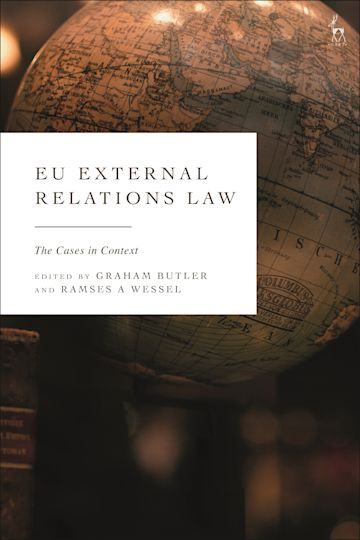
Butler & Wessel: EU External Relations Law: The Cases in Context
Marking the 50th anniversary of the influential ERTA doctrine, this book analyses and contextualises the entire breadth of the jurisprudence of EU external relations law through a systematic, case-by-case account of the field.
The entire framework of EU external relations law has been built from the ground up by the jurisprudence of the Court of Justice of the European Union. At the beginning of the field's emergence, the legal questions to be answered concerned the division of powers and competence between, firstly, the Member States and that of the Union; and secondly, the division of powers and competence between the different institutions of the Union. Questions on such matters continue to be asked, but more contemporarily, new legal questions have arisen that have been in need of adjudication, including questions concerning the autonomy of Union law; the relationship between the Union and other international organisations; the relationship between Union law and international law; the scope and breadth of international agreements; amongst others.
The book features established academic scholars, judges, agents of institutions and Member States, and legal practitioners in the field of EU external relations law, analysing over 90 cases in which the Court has legally shaped the theory and practice of the external dimension of legal Europe.
Sunday, February 13, 2022
Bradley, Goldsmith, & Hathaway: The Rise of Nonbinding International Agreements: An Empirical, Comparative, and Normative Analysis
The Article II treaty process has been dying a slow death for decades, replaced by various forms of “executive agreements.” What is only beginning to be appreciated is the extent to which both treaties and executive agreements are increasingly being overshadowed by another form of international cooperation: nonbinding international agreements. Not only have nonbinding agreements become more prevalent, but many of the most consequential (and often controversial) U.S. international agreements in recent years have been concluded in whole or in significant part as nonbinding international agreements. Despite their prevalence and importance, nonbinding international agreements are not currently subject to any of the domestic statutory or regulatory requirements that apply to binding agreements. As a result, they are not centrally monitored or collected within the executive branch, and they are not systematically reported to Congress or disclosed to the public.
This Article focuses on three of the most important types of nonbinding international agreements concluded by the United States: (1) high-level formal agreements; (2) joint statements and communiques; and (3) nonbinding agreements concluded by administrative agencies. After describing these categories and their history, the Article presents the first empirical study of U.S. nonbinding agreements, drawing on two new databases that together include more than 2100 nonbinding agreements. Based on this study, the Article argues that many of the concerns that prompted Congress to regulate binding executive agreements starting in the 1970s also apply to nonbinding agreements. Finally, drawing in part on insights obtained from a comparative assessment of the practices and reform discussions taking place in other countries, the Article suggests legal changes designed to enhance coordination and accountability.
Tuesday, July 20, 2021
Green & McKenzie: Looking Without and Looking Within: Nestlé v. Doe and the Legacy of the Alien Tort Statute
Thursday, May 20, 2021
Aust & Kleinlein: Encounters between Foreign Relations Law and International Law: Bridges and Boundaries
Foreign relations law and public international law are two closely related academic fields that tend to speak past each other. As this innovative volume shows, the two are closely interrelated and depend on each other for their mutual construction and identity. A better understanding of this relationship is of vital importance for upholding important constitutional values like democracy, the rule of law and the protection of human rights, while enabling states to engage in meaningful forms of international cooperation. The book takes a close look at the encounters between the two fields and offers perspectives for a constructive engagement between the two. Collectively, the contributions argue that the delimitation between the two fields occurs in a hybrid zone of interaction which requires both bridges and boundaries: bridges for the construction of the relationship between the two fields, and boundaries for preserving key normative expectations of both domestic and international law.
Tuesday, May 4, 2021
Grossman & Pruitt: Litigating U.S. Policy Toward the International Criminal Court
Tuesday, March 30, 2021
Atilano: International Criminal Law in Mexico: National Legislation, State Practice and Effective Implementation
This book puts forward proposals for solutions to the current gaps between the Mexican legal order and the norms and principles of international criminal law. Adequate legislative measures are suggested for compliance with international obligations. The author approaches the book's subject matter by tracing all norms related to the prosecution of core crimes and contextualizing each of the findings with a brief historical and political account. Additionally, state practice is analyzed, identifying patterns and inconsistencies. This approach is new in offering a wide perspective on international criminal law in Mexico. Relevant legal documents are analyzed and annexed in the book, providing the reader with a useful guide to the topics analyzed. Issues including the following are examined: the incorporation of core crimes in the Mexican legal order, military jurisdiction, the war crimes definition under Mexican law, unaddressed atrocities, state practice and future challenges to combat impunity.