Showing posts with label International Labor Law. Show all posts

Monday, June 29, 2026

Brudney & Bellace: The Elgar Companion to the Law and Practice of the International Labour Organization

James J. Brudney
(Fordham Univ. - Law) & Janice R. Bellace (Univ. of Pennsylvania - Wharton School) have published The Elgar Companion to the Law and Practice of the International Labour Organization (Edward Elgar Publishing 2026). Here's the abstract:

This comprehensive book analyzes the laws and practices of the International Labour Organization (ILO), addressing the distinctive role of tripartism within the ILO governance structure since 1919, and analyzing the organization’s contributions to the protection and promotion of workers’ rights on a global scale.

Contributors explore a breadth of issues crucial to the ILO’s objective of achieving decent work in collaboration with governments, workers, and employers. Topics covered include application of the ILO’s ‘fundamental principles’ covering freedom of association, equality, safety and health, and the prevention of forced labour and child labour. In addition, the book addresses provision of social security benefits, the development of effective employment policies, the implementation of functional labour inspection, and the recognition of indigenous peoples’ voices. Chapters also present a granular analysis of the ILO supervisory system, outlining the value and limits of the organization’s soft power. The Companion envisions the ILO’s future, highlighting the obstacles that prevent secure worker rights and protections in both the informal and digital economies, as well as the impact of ILO conventions on trade agreements.

Saturday, November 1, 2025

Seminar Materials: The Right to Strike under International Law

The Nathanson Centre on Transnational Human Rights, Crime and Security at York University recently hosted a seminar bringing together leading international labour law experts to examine whether the right to strike is protected under ILO Convention No. 87 — the question currently before the International Court of Justice. The seminar materials - including a written recap of the discussion, the full video recording, edited transcripts of the presentations and Q&A, and a French translation of the recap - are available here.

Thursday, October 9, 2025

Seminar: The Right to Strike under International Law

On October 16, 2025, the Jack and Mae Nathanson Centre on Transnational Human Rights, Crime and Security at York University will host an online seminar on "The Right to Strke Under International Law." Details are here.

Monday, August 14, 2023

LeClercq: A Worker-Centered Trade Policy

Desiree LeClercq (Cornell Univ. - School of Industrial and Labor Relations) has posted A Worker-Centered Trade Policy (Columbia Journal of Transnational Law, Vol. 61, No. 3, 2023). Here's the abstract:

What is a “worker-centered” trade policy? The Biden administration claims that it means protecting all workers—foreign and American—from exploitative working conditions in trade sectors. The administration’s vigorous enforcement of international labor rights suggests a significant departure from previous U.S. trade priorities centered on domestic interests. For economic and humanitarian reasons, various policymakers and scholars celebrate these developments. They optimistically assume that the administration’s new trade policy will influence foreign governments and facilities to comply with international labor rights in trade if the costs of noncompliance outweigh the benefits. They also assume that the policy will influence compliance with strong labor protections as negotiated on the international platform. Both assumptions are misplaced.

Outside the trade context, governments, employers, and workers negotiate how international labor rights mani-fest in their countries based on pragmatic issues such as political ideologies, economic capacity, and legal systems. Those actors tend to respect those labor rights because they actively participate in the design, monitoring, and enforcement processes. Despite its newfound interest in ensuring compliance with international labor rights under U.S. trade agreements, the Biden administration excludes foreign workers, employers, and counterpart governments from those processes. That exclusion risks obscuring and distorting enforcement predictability, perceptions of legitimacy, and the scope of international labor rights protections within and outside the United States—all of which may reduce or weaken compliance and protections for workers in trade sectors. If the administration sincerely intends to protect workers from trade-related exploitation worldwide, it must stop reinforcing its own discretion and control and start reinforcing the participatory processes embedded in international labor rights.

Sunday, February 26, 2023

Langille & Trebilcock: Social Justice and the World of Work Possible Global Futures: Essays in Honour of Francis Maupain

Brian Langille
(Univ. of Toronto) & Anne Trebilcock (formerly, Legal Adviser, International Labor Organizations) have published Social Justice and the World of Work Possible Global Futures: Essays in Honour of Francis Maupain (Hart Publishing 2023). The table of contents is here. Here's the abstract:
In this book, leading international thinkers take up the demanding challenge to rethink our understanding of social justice at work and our means for achieving it – at a time when global forces are tearing the familiar fabric of our working lives and the laws regulating them. When fabric is torn we can see deeply into it, understand its structural weaknesses, and imagine alterations in the name of resilience and sustainability. Seizing that opportunity, the authoritative commentators examine the lessons revealed by the pandemic and other global shocks for our ideas about justice at work, and how to advance that cause in the world as we now find it. The chapters deliver critical re-assessments of our goals, explore our new challenges, and creatively re-imagine trajectories for progress on two global fronts - via international institutions and by a myriad of other transnational techniques.

Saturday, July 30, 2022

Chilton & Woda: The Expanding Universe of Bilateral Labor Agreements

Adam Chilton (Univ. of Chicago - Law) & Bartosz Woda (Univ. of Chicago - Law) have posted The Expanding Universe of Bilateral Labor Agreements (Theoretical Inquiries in Law, Vol. 23, no. 2, 2022). Here's the abstract:
In the seventy-five years since the end of World War II, pairs of countries have entered into over a thousand bilateral labor agreements (BLAs) to regulate the cross-border flow of workers. These agreements have received little public or academic attention. This is likely, in part, because there is limited data or easily available information on BLAs. This Article hopes to change that by introducing three new resources: (1) a dataset documenting the formation of over 1,200 BLAs; (2) a corpus including the texts of over 800 BLAs; and (3) a dataset coding whether over 500 BLAs mention twenty topics that the ILO has identified as best practices for these agreements. Using this data, we show that, unlike some other forms of bilateral agreements, the rate of BLAs being signed has remained relatively high during the first two decades of the twenty-first century. Additionally, we also show evidence that, although many BLAs were formed during this period, relatively few agreements include various worker protections advocated for by activists, scholars, and NGOs.

Wednesday, July 20, 2022

Special Issue: Bilateral Labor Agreements

The latest issue of Theoretical Inquiries in Law (Vol. 23, no. 2, 2022) focuses on "Bilateral Labor Agreements." The table of contents is here.

Friday, March 25, 2022

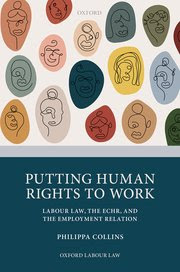
Collins: Putting Human Rights to Work: Labour Law, the ECHR, and the Employment Relation

Philippa Collins
(Univ. of Bristol - Law) has published Putting Human Rights to Work: Labour Law, the ECHR, and the Employment Relation (Oxford Univ. Press 2022). Here's the abstract:
The very existence of an employment relationship places the human rights of a worker at risk. Employers can, and frequently do, exercise their managerial and disciplinary powers in a manner that interferes with the most fundamental rights of the individual worker. Adequate safeguards against such infringements are necessary if individuals are to receive full protection of their rights. This book examines how far the labour laws of England and Wales offer such guarantees, with a particular focus on dismissal law. The chapters reflect on the relationship between employment, labour, and human rights before conducting a detailed and critical analysis of the scope, shape, and application of domestic employment law. The framework for evaluation is drawn from the case law of the European Court of Human Rights, as it develops a principled and tailored approach to how the rights contained in the European Convention on Human Right should be enforced in working relationships. Statutory mechanisms, such as the law of unfair dismissal, and common law causes of action are examined and found to be lacking in their capacity to vindicate and enforce the human rights of workers. This book culminates in the proposal and elaboration upon an innovative solution, the Bill of Rights for Workers, that would draw on the successes of human rights and labour law instruments to render the Convention rights directly enforceable in the relationship between a worker and their employer.

Tuesday, May 25, 2021

Conference: Bilateral Labor Agreements

On June 6-8, 2021, Tel Aviv University will host an online conference on "Bilateral Labor Agreements." Program and registration are here.

Wednesday, December 9, 2020

Nacer: Les normes internationales du travail entre global et local : Etude internationale et comparée de l'interprétation des instruments de l'OIT

Rachid Nacer
has published Les normes internationales du travail entre global et local : Etude internationale et comparée de l'interprétation des instruments de l'OIT (L'Harmattan 2020). Here's the abstract:
Le sujet de l'interprétation soulève de nombreuses interrogations, tant en matière institutionnelle que substantielle, à la fois au sein de l'Organisation internationale du travail (OIT) et en-dehors. Le regain d'intérêt pour les travaux de l'instance genevoise conduit à une situation où la question de l'interprétation de ses instruments se trouve renouvelée, complexifiée et fragmentée devant la diversité des acteurs qu'elle implique. Cet ouvrage propose une réflexion pour savoir si cette configuration permet de rendre effectifs des textes adoptés en vue de donner corps à la justice sociale. Sont ainsi analysés différents niveaux dans lesquels les instruments de l'OIT sont susceptibles d'être utilisés, à travers l'étude successive du cadre international puis de situations nationales, sur la base des jurisprudences canadienne, française et sud-africaine.

Saturday, August 22, 2020

Wolf: The Fight to Globalize Labor: Understanding the Role of Activists in the Spread of International Norms

Andrew B. Wolf (Univ. of Wisconsin - Sociology) has published The Fight to Globalize Labor: Understanding the Role of Activists in the Spread of International Norms (Law & Society Review, Vol. 54, no. 3, pp. 607-642, September 2020). Here's the abstract:
International relations scholars have traditionally focused on state‐centered accounts of international legal norm development between nations while sociolegal scholars have focused on Weberian notions of occupational authority. This study advances a constructivist sociolegal approach emphasizing activist action as playing a unique role in shaping international norms. Specifically, this study investigates labor activists' intervention in U.S. bilateral and multilateral free trade agreements (FTAs) to examine why labor activists chose to initiate FTA disputes as a social movement tactic and how strategic interaction with international legal systems has helped them institutionalize and proliferate the International Labor Organizations' core labor standards. Through semi‐structured interviews with legal, union, and government officials, alongside a content analysis of cases filed under the U.S. FTA system, this study shows the role activists played in advancing “globalized” standards in international law. This study finds that activists spread norms through a gradual mechanism of accretion, which focuses on the creation of standards and international legal standing over the individual outcomes of any given case.

Tuesday, July 21, 2020

Call for Contributions: Labour Migration in the time of COVID-19: Inequalities and Perspectives for Change

A call for contributions has been issued for a volume on "Labour Migration in the time of COVID-19: Inequalities and Perspectives for Change," to be edited by Giulia Ciliberto (Univ. of Naples Federico II) and Fulvia Staiano (Giustino Fortunato Univ. and National Research Council of Italy). The call is here.

Friday, March 13, 2020

Vogt et al.: The Right to Strike in International Law

Jeffrey Vogt, Janice Bellace, Lance Compa, K D Ewing, John Hendy, Klaus Lörcher, & Tonia Novitz have published The Right to Strike in International Law (Hart Publishing 2020). Here's the abstract:

This monograph was originally developed as a direct response to the claim made by members of the 'Employers Group' at the 2012 International Labour Conference, namely that the right to strike is not protected in international law, and in particular by ILO Convention 87 on the right to freedom of association.

The group's apparent aim was to sow sufficient doubt as to the existence of an internationally protected right so that governments might seek to limit or prohibit the right to strike at the national level while still claiming compliance with their international obligations. In consequence, some governments have seized on the employers' arguments to justify new limitations on that right.

The Right to Strike in International Law not merely refutes this claim but is the only complete and exhaustive analysis on this subject. Based on deep legal research, it finds that there is simply no credible basis for the claim that the right to strike does not enjoy the protection of international law; indeed, the authors demonstrate that it has attained the status of customary international law.

Saturday, December 14, 2019

Sunday, November 17, 2019

Pauwelyn: Is Globalization Finally Re-Balancing? Novel Ways of Leveling the Playing Field for Labor

Joost Pauwelyn (Graduate Institute of International and Development Studies) has posted Is Globalization Finally Re-Balancing? Novel Ways of Leveling the Playing Field for Labor. Here's the abstract:
Globalization as well as global governance, especially since the 1990s, has suffered from an imbalance to the detriment of labor, and in favor of the free flow of goods, services and capital (benefitting disproportionately capital as compared to labor). More recently, however, some re-balancing may be occurring: less liberalization and protection of cross-border trade and investment flows; more protection of labor. This contribution offers a number of novel, unorthodox instruments that have emerged or have been discussed or proposed that may slowly “level the playing field” in favor of labor. Some are (i) focused on liability of multinational parent or sourcing companies, others (ii) target the traded product (be it by means of import duties or income tax adjustments), yet others (iii) concentrate on work or the worker him or herself (anti-trust enforcement in favor of workers; construing “data as labor” or putting in place mechanisms allowing for “tele-migration”). These avenues are novel in that they are not focused on employers in the production country, nor centered around ILO conventions with labor commitments on host states and relatively soft compliance mechanisms. Indeed, most of these instruments are market- or technology-based, hard-law instruments embedded in domestic law or arbitration, or in international organizations or treaties outside of the ILO.

Monday, August 19, 2019

Helfer: Pushback Against Supervisory Systems: Lessons for the ILO from International Human Rights Institutions

Laurence R. Helfer (Duke Univ. - Law) has posted Pushback Against Supervisory Systems: Lessons for the ILO from International Human Rights Institutions. Here's the abstract:

The ILO supervisory system, which has reviewed compliance with international labor standards for nearly all of the organization’s 100-year history, is widely hailed as cornerstone of its institutional architecture. In 2012, however, the employer representatives challenged the longstanding position of ILO expert bodies that Convention No. 87 on freedom of association implicitly protects the right to strike. The resulting “crisis of tripartism” has raised questions about the proper interpretation of international labor law and the future competences of ILO monitoring mechanisms.

This chapter, a contribution to a forthcoming edited volume on the centenary of the ILO, offers a wider perspective on these events. It begins by analyzing how states and non-state actors have pushed back against the treaty monitoring bodies created by UN human rights conventions. The chapter then compares the similarities and differences between pushback against human rights treaty bodies and challenges to ILO expert committees over the right to strike. The chapter concludes by highlighting ongoing UN and ILO initiatives aimed at strengthening international supervisory systems.

Saturday, May 4, 2019

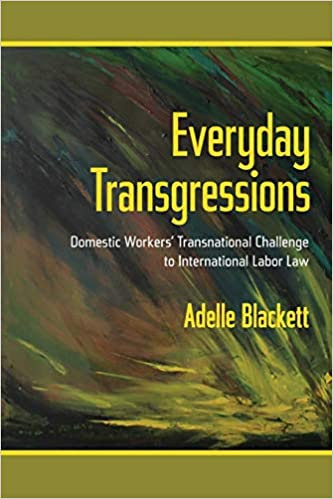
Blackett: Everyday Transgressions: Domestic Workers' Transnational Challenge to International Labor Law

Adelle Blackett
(McGill Univ. - Law) has published Everyday Transgressions: Domestic Workers' Transnational Challenge to International Labor Law (Cornell Univ. Press 2019). Here's the abstract:
Adelle Blackett tells the story behind the International Labour Organization's (ILO) Decent Work for Domestic Workers Convention No. 189, and its accompanying Recommendation No. 201 which in 2011 created the first comprehensive international standards to extend fundamental protections and rights to the millions of domestic workers laboring in other peoples' homes throughout the world. As the principal legal architect, Blackett is able to take us behind the scenes to show us how Convention No. 189 transgresses the everyday law of the household workplace to embrace domestic workers' human rights claim to be both workers like any other, and workers like no other. In doing so, she discusses the importance of understanding historical forms of invisibility, recognizes the influence of the domestic workers themselves, and weaves in poignant experiences, infusing the discussion of laws and standards with intimate examples and sophisticated analyses. Looking to the future, she ponders how international institutions such as the ILO will address labor market informality alongside national and regional law reform. Regardless of what comes next, Everyday Transgressions establishes that domestic workers' victory is a victory for the ILO and for all those who struggle for an inclusive, transnational vision of labor law, rooted in social justice.

Saturday, April 13, 2019

Conference: ILO100: Law for Social Justice

On April 15-17, 2019, the International Labour Organization will host a conference to celebrate its centenary: "ILO100: Law for Social Justice." The program is here.

Tuesday, January 2, 2018

Häberli: Labour Standard Enforcement through Economic Treaties

Christian Häberli (World Trade Institute) has posted Labour Standard Enforcement through Economic Treaties. Here's the abstract:

Recent economic treaties contain references to labour standards with increasing specificity and stringent enforcement mechanisms. However, despite evidence for continuing massive violations of workers’ rights, forced and child labour, these mechanisms are very seldom used. This article focuses on enforcement in respect of gross and continuing violations of so-called peremptory standards i.e. those generally recognised as norms from which no derogation is permitted (cogent law or ius cogens). It looks at a number of new trade and investment agreements, and conditional tariff preferences. Goods and services produced in violation of clearly peremptory standards not only raise the question of importer involvement. These violations may also cause trade distortions against which importers may take countermeasures, sometimes explicitly in cooperation with non-state stakeholders. Sanctions may consist, for instance, in suspensions of tariff concessions or outright import bans in response to labour standard violations creating trade and investment conditions.

A possible barrier against sanctions are the non-discrimination rules enshrined in all economic treaties which seem to overprotect policy space and hence to also prevent, for instance, countermeasures against social dumping. This is particularly true for the rules framework of the World Trade Organization (WTO) which has no social clauses, but also for economic treaties with few stringent commitments, and a dearth of case law. Adjudicators in litigation cases would then have to decide whether ius cogens does take precedence over WTO and other economic treaty rules. Even though this has never occurred, this article argues that when trade measures are taken against violations of cogent law, they will withstand legal challenges better than would appear from looking at comparable WTO cases involving public morals. At the same time, producers respecting these international bottom lines for employment policies can defend their treaty-enshrined market access rights against unilateral standard setting and protectionism in disguise.

It is too early to contend that economic treaty implementation has become more holistic by adding social and environmental dumping to the list of trade distortions subject to trade remedies. Nonetheless, this article concludes that some peremptory labour standards have become easier to enforce. International Economic Treaty Law still protects against non-trade distorting sanctions. But the new venues described here can limit the race to the bottom, and contribute to sustainable employment even in countries needing ‘more’ rather than ‘better’ jobs.

Thursday, April 27, 2017