Saturday, October 8, 2022

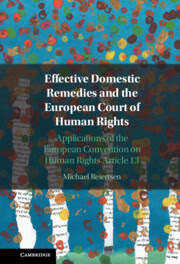
Reiertsen: Effective Domestic Remedies and the European Court of Human Rights: Applications of the European Convention on Human Rights Article 13

Michael Reiertsen
has published Effective Domestic Remedies and the European Court of Human Rights: Applications of the European Convention on Human Rights Article 13 (Cambridge Univ. Press 2022). Here's the abstract:
In Malone v. UK (Plenary 1984), the right to an effective domestic remedy in the European Convention on Human Rights Article 13 was famously described as one of the most obscure clauses in the Convention. Since then, the European Court of Human Rights has reinforced the scope and application of the right. Through an analysis of virtually all of the Court's judgments concerning Article 13, the book exhaustively accounts for the development and current scope and content of the right. The book also provides normative recommendations on how the Court could further develop the right, most notably how it could be a tool to regulate the relationship between domestic and international protection of human rights. In doing so, the book situates itself within larger debates on the enforcement of the entire Convention such as the principle of subsidiarity and the procedural turn in the Court's case law.

Call for Submissions: Protecting the Environment in Armed Conflict: The Legal and Policy Framework of the Future (International Review of the Red Cross)

The International Review of the Red Cross has issued a call for submissions on "Protecting the Environment in Armed Conflict: The Legal and Policy Framework of the Future" for publication in an upcoming issue. The deadline is November 14, 2022. The call is here.

Scheu: Creation and Implementation of a Multilateral Investment Court

Julian Scheu
(Univ. of Cologne - Law) has published Creation and Implementation of a Multilateral Investment Court (Nomos 2022). The table of contents is here. Here's the abstract:
This book deals with the ongoing reform process for investor-state dispute settlement in UNCITRAL Working Group III, in particular the proposal to create a multilateral investment tribunal (MIC). The book covers key elements of the MIC proposal, such as the institutional framework of the court, the design of an appeals mechanism, the use of class-law settlement procedures, and the establishment of an advisory center for developing countries. In addition, the selection and appointment of judges is discussed. It also explores the following questions: How can the MIC be integrated into the existing ISDS system? How can the implementation of its decisions be ensured? Each chapter highlights the legal issues to be discussed and places them in a larger context to offer an understanding of the core questions and how they are related to each other.

Conference: Human Rights Due Diligence, Price and Remuneration

On October 10, 2022, the British Institue of International and Comparative Law will hold its annual Human Rights Due Diligence Forum conference online. The theme is: "Human Rights Due Diligence, Price and Remuneration." Program and registration are here.

Golia, Kettemann, & Kunz: Digital Transformations in Public International Law

Angelo Jr. Golia
, Matthias C. Kettemann, & Raffaela Kunz have published Digital Transformations in Public International Law (Springer 2022). The table of contents is here. This volume is available open access. Here's the abstract:

Souveränität, Sicherheit, Rechte, Partizipation: Diese vier Makro-Themen sind durch die Auswirkungen der digitalen Technologien auf die Struktur des Völkerrechts stark betroffen. Aber welche Rolle spielt das Völkerrecht für das Internet? Und wie haben das Internet und die Plattformen, Cyberwaffen und Multistakeholder-Ansätze zur Rechtsetzung das Völkerrecht beeinflusst? Dieses Buch untersucht die wechselseitigen Einflüsse zwischen digitalen Technologien und Völkerrecht und trägt dazu bei, den hartnäckigen Mythos vom Internet als unreguliertem Raum zu entkräften. Auf diese Weise zeigt es aktuelle und zukünftige Forschungsfelder auf, die an der Schnittstelle zwischen Völkerrecht und digitalen Technologien entstehen und in Zukunft noch an Bedeutung gewinnen werden. Mit Beiträgen von Angelo Jr. Golia, Matthias Kettemann, Raffaela Kunz, Pia Hüsch, Edoardo Celeste, Uchenna Jerome Orji, Alena Douhan, Stefanie Schmahl, Rossella Pulvirenti, Adam Krzywoń, Katharina Luckner und Vera Strobel.

Sovereignty, security, rights, participation: these four macro-issues have been deeply affected by the impact of digital technologies on the inner infrastructures of public international law. But what role does international law play for the internet? And how have the internet and the platforms, rogue actors, cyber weapons, and multistakeholder approaches to law-making influenced international law? This book examines the reciprocal influences between digital technologies and public international law and contributes to further debunk the persisting myth of the internet as an unregulated space. By these means, it current and future fields of inquiry emerging from the interface between public international law and digital technologies which will become even more relevant in the future. With contributions by Angelo Jr Golia, Matthias Kettemann, Raffaela Kunz, Pia Hüsch, Edoardo Celeste, Uchenna Jerome Orji, Alena Douhan, Stefanie Schmahl, Rossella Pulvirenti, Adam Krzywoń, Katharina Luckner and Vera Strobel.

New Issue: Chinese Journal of International Law

The latest issue of the Chinese Journal of International Law (Vol. 21, no. 2, June 2022) is out. Contents include:
  • Articles
    • Sienho Yee, Territory in the Work of the Institut de Droit International
    • Karolina Wierczyńska, International Prosecutors Acting before National Courts?: The Rome Statute System and the Ultimate Approach to Positive Complementarity
  • Comment
    • Chao Wang & Taixia Shen, Adaptation of International Law in the Chinese Constitution and Legal System: New Developments

Friday, October 7, 2022

New Issue: Italian Review of International and Comparative Law

The latest issue of the Italian Review of International and Comparative Law (Vol. 2, no. 1, 2022) is out. Contents include:
  • Massimo Iovane, Non-Recognition of Territorial Acquisitions by the Use of Armed Force: The Status of Jerusalem before Italian Courts
  • Roberto Virzo, Sea-Level Rise and State of Necessity: Maintaining Current Baselines and Outer Limits of National Maritime Zones
  • Gabriele Asta, The ECtHR’s Decision to Dismiss the First Request Submitted Under Article 29 of the Convention on Human Rights and Biomedicine: Putting Its Sleeping Advisory Competence Back in the Attic
  • Federico Casolari, Italy’s Contribution to a More Robust International Architecture for the cbrn Legal Landscape: A Critical Appraisal
  • Paolo Passaglia, The Italian Constitutional Court and the Use of Comparative Law: An Empirical Analysis
  • Donato Greco, Italy and the Enforcement of Foreign Judgments on Third States’ Tort Liability for Sponsoring Terrorism: The Conundrum of Jurisdictional Immunity of Foreign States in the Presence of Serious Violations of Human Rights
  • Pietro Franzina, Violation of Public Policy as a Ground for Non-Recognition of Foreign Judgments – The Case of Judgments Preceded by a Mareva-Type Freezing Order
  • Simone Marinai, Stateless Status and Expulsion from Italian Territory: Some Remarks on the Recent Case Law of the Corte di Cassazione
  • Filippo Venturi, War and Peace in the Context of the Multilevel Legal Order for the Protection of the Fundamental Rights of the Persons Requested for the Execution of a European Arrest Warrant: Some Remarks on the Decisions No. 216 and 217 of 2021 of the Italian Constitutional Court
  • Elettra Stradella, The Last Presidential (Re)Election in Italy: Internal and Exogenous Factors in the Framework of an Unsatisfactory Discipline of Presidential Election
  • Ilaria Queirolo, International Child Abduction and the 1980 Hague Convention in Practice: The Biran Case
  • Luigi Prosperi, Legal Effects of the Ratification by Italy of the Amendments to the icc Statute on Aggression
  • Francesca Capone, The Development of the Italian Doctrine in the Words of Antonio Cassese: Towards a More Pragmatic Approach?
  • Martina Buscemi, What’s in a name? International Organizations in Search of an Identity
  • Pasquale Annicchino, The Fragmentation of Human Rights. Case Studies from a Post-Arab Spring Context

New Issue: European Convention on Human Rights Law Review

The latest issue of the European Convention on Human Rights Law Review (Vol. 3, no. 3, 2022) is out. Contents include:
  • Vassilis P Tzevelekos & Kanstantsin Dzehtsiarou, The Judicial Discretion of the European Court of Human Rights: The Years of Plenty, and the Lean Years
  • Françoise Tulkens, Judicial Activism v Judicial Restraint: Practical Experience of This (False) Dilemma at the European Court of Human Rights
  • George Tsebelis, What Determines the Judicial Discretion of the European Court of Human Rights?
  • Lize Glas & Jasper Krommendijk, A Strasbourg Story of Swords and Shields: National Courts’ Motives to Request an Advisory Opinion from the ECtHR Under Protocol 16
  • Jeremy Letwin, A Utilitarian Account of Article 3 echr
  • Sarah Ganty, The Double-Edged ECtHR Lăcătuş Judgment on Criminalisation of Begging: Da Mihi Elimo Sinam Propter Amorem Dei

New Issue: Michigan Journal of International Law

The latest issue of the Michigan Journal of International Law (Vol. 43, no. 3, 2022) is out. Contents include:
  • Reuven Avi-Yonah & Young Ran (Christine) Kim, Tax Harmony: The Promise and Pitfalls of the Global Minimum Tax
  • David Eichert, Decolonizing the Corpus: A Queer Decolonial Re-examination of Gender in International Law's Origins
  • Robert Howse & Amin R. Yacoub, Litigating Terror in The Sinai After The Egyptian Spring Revolution: Should States Be Liable to Foreign Investors for Failure to Prevent Terrorist Attacks?
  • Benedict Sheehy & Ying Chen, Let Them Eat Rights: Re-Framing the Food Insecurity Problem Using a Rights-Based Approach
  • Tally Kritzman-Amir, Asylum-Seekers are Not Bananas Either: Limitations on Transferring Asylum-Seekers to Third Countries

Thursday, October 6, 2022

Ebbesson & Hey: The Cambridge Handbook of the Sustainable Development Goals and International Law

Jonas Ebbesson
(Stockholms Universitet) & Ellen Hey (Erasmus Universiteit Rotterdam) have published The Cambridge Handbook of the Sustainable Development Goals and International Law (Cambridge Univ. Press 2022). Here's the abstract:
In 2015, the United Nations established seventeen Sustainable Development Goals (SDG) that aimed 'to achieve a better and more sustainable future for all' by 2030. The chapters within this collection address each of these SDGs, considering how they relate to one another and international law, and what institutions could aid their implementation. Development has been a contentious topic since the decolonization period after World War II, and issues surrounding sustainable development are necessarily impacted by the multifaceted relationship between the Global South and Global North. Confronting the context and challenge of sustainable development, this collection outlines how the international economic system problematizes the attainment of the SDGs. Introducing a novel, cosmopolitan approach, this book offers new ways of understanding sustainable development and suggests potential solutions so that we might finally achieve it.

Inaugural Robert E. Dalton Roundtable on International Law in Government Practice

On October 13, 2022, the American Society of Internatioanl Law will host the inaugural Robert E. Dalton Roundtable on International Law in Government Practice. Details are here.

Hovell & Hughes: Self Defence and Its Dangerous Variants: Afghanistan and International Law

Devika Hovell (London School of Economics) & Michelle Hughes (London School of Economics) have posted Self Defence and it Dangerous Variants: Afghanistan and International Law. Here's the abstract:
The question as to whether Operation Enduring Freedom was justified under international law may seem one that has passed its practical use-by date. Yet, as may be disturbingly apparent from current global conflicts, justifications relied on by certain states in the past can influence their credible use by other states in the future and diminish opportunities to refute them. In this essay, the authors examine the international legal arguments used by the United States and its allies to justify the intervention in Afghanistan. They look at the impact these justifications had on the authority, purpose and expectations of Operation Enduring Freedom, as well as on relevant frameworks for cooperation and acceptable limits of collateral damage. The authors also look at the impact these justifications have had on interpretations of the law of self-defence in modern conflict more broadly.

Johns: International Law and Digitalisation

Fleur Johns (Univ. of New South Wales - Law) has posted International Law and Digitalisation (in Cambridge History of International Law (Vol. XII): International Law Since the End of the Cold War, Eyal Benvenisti & Dino Kritsiotis eds., forthcoming). Here's the abstract:
Digitalisation has wrought fundamental change in the stuff of international law since the end of the Cold War: the objects towards which it is oriented; the subjects by and for which it is understood to be made; the matters with which it is concerned; the materials, rhythms, politics, protagonists and modalities of its operation. These changes have been entangled with others and have helped to fuel and shape many of them. The claim is not that digitalisation has made international law stronger or weaker across the board or that it has overridden all prior or alternative logics of the discipline. Rather, this chapter contends that digitalisation has enlivened multiple tonalities within the discipline of international law and ramified a range of conflicts within it. This chapter will first explain what is meant by digitalisation and reflect briefly on the conundrum of ‘Cold War’ periodisation before turning to various sub-domains into which international lawyers have traditionally subdivided their field to survey the ingression of the digital in each. This sequence begins with the digitalisation of the global economy and its international legal infrastructure. It continues with the digitalisation of war as practised and comprehended by international lawyers and concludes with the digitalisation of global politics as imagined and conducted in the international legal field. A final section will reflect on the significance of this ingression for post-Cold War hubris, New Cold War entrenchment, and allegiances and struggles that surpass both.

New Issue: International Community Law Review

The latest issue of the International Community Law Review (Vol. 24, no. 5, 2022) is out. Contents include:
  • Romola Adeola, Bridging the Accountability Gap in the Protection of Internally Displaced Persons: Non-State Actors Under the Kampala Convention
  • Mariana Clara de Andrade, General Principles of Procedural Law in the Practice of the WTO Appellate Body
  • Marco Longobardo, The Standing of Indirectly Injured States in the Litigation of Community Interests before the ICJ: Lessons Learned and Future Implications in Light of The Gambia v. Myanmar and Beyond
  • Christian Tomuschat, The 2030 Sustainable Development Goals: The Quest for a Perfect World Order

Wednesday, October 5, 2022

Bédard & Pearsall: Reflections on International Arbitration - Essays in Honour of Professor George Bermann

Julie Bédard
(Skadden, Arps, Slate, Meagher & Flom LLP) & Patrick W. Pearsall (Allen & Overy LLP) have published Reflections on International Arbitration - Essays in Honour of Professor George Bermann (Juris Publishing 2022). The table of contents is here.

Bode & Huelss: Autonomous Weapons Systems and International Norms

Ingvild Bode
(Univ. of Southern Denmark - Center for War Studies) & Hendrik Huelss (Univ. of Southern Denmark - Center for War Studies) have published Autonomous Weapons Systems and International Norms (McGill-Queen's Univ. Press 2022). Here's the abstract:

Autonomous weapons systems seem to be on the path to becoming accepted technologies of warfare. The weaponization of artificial intelligence raises questions about whether human beings will maintain control of the use of force. The notion of meaningful human control has become a focus of international debate on lethal autonomous weapons systems among members of the United Nations: many states have diverging ideas about various complex forms of human-machine interaction and the point at which human control stops being meaningful.

In Autonomous Weapons Systems and International Norms Ingvild Bode and Hendrik Huelss present an innovative study of how testing, developing, and using weapons systems with autonomous features shapes ethical and legal norms, and how standards manifest and change in practice. Autonomous weapons systems are not a matter for the distant future - some autonomous features, such as in air defence systems, have been in use for decades. They have already incrementally changed use-of-force norms by setting emerging standards for what counts as meaningful human control. As UN discussions drag on with minimal progress, the trend towards autonomizing weapons systems continues.

Call for Papers: Global Crisis and Global Legal Orders: 'What should we now discuss for the Future of Global Legal Ordering?'

The Global Constitutionalism Study Group and the Institute of Comparative Law at Waseda University have issued a call for papers for a conference, in the hybrid format, on "Global Crisis and Global Legal Orders: 'What should we now discuss for the Future of Global Legal Ordering?'” on March 1-2, 2023, in Tokyo. The call is here.

Tuesday, October 4, 2022

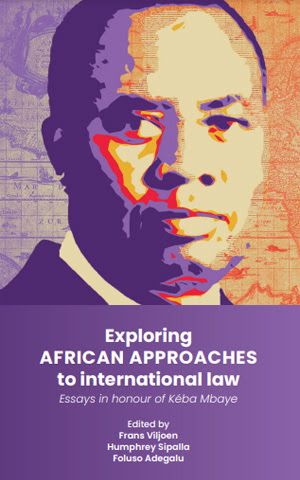
Viljoen, Sipalla, & Adegalu: Exploring African approaches to international law: Essays in honour of Kéba Mbaye

Frans Viljoen
, Humphrey Sipalla, & Foluso Adegalu have published Exploring African approaches to international law: Essays in honour of Kéba Mbaye (Pretoria Univ. Law Press 2022). The table of contents is here. This volume is available open access.

Monday, October 3, 2022

JFIEL Symposium 2022: Lived Realities and Critical Spaces in International Law

The Jindal Forum for International and Economic Laws has posted its 2022 symposium. The topic is: "Lived Realities and Critical Spaces in International Law." Details are here.

New Additions to the UN Audiovisual Library of International Law

The Codification Division of the UN Office of Legal Affairs recently added the following materials to the UN Audiovisual Library of International Law: a Mini-Series on Diplomatic and Consular Relations by Alina Miron (available in French).

The Audiovisual Library of International Law is also available as a podcast on SoundCloud and can also be accessed through the relevant preinstalled applications on Apple or Google devices, or through the podcast application of your preference by searching “Audiovisual Library of International Law.”

Call for Submissions: Ius Inter Gentes – Revista de Derecho Internacional y Relaciones Internacionales

Ius Inter Gentes – Revista de Derecho Internacional y Relaciones Internacionales has issued a call for submissions for its fourth volume (2023). The call is here.

Saturday, October 1, 2022

New Issue: Global Trade and Customs Journal

The latest issue of Global Trade and Customs Journal (Vol. 17, no. 10, 2022) is out. Contents include:
  • Davide Rovetta, Customs Valuation in the European Union: Back to the Fifties Thanks to the Court of Justice of the European Union
  • Yuliia Kucheriava, Russia’s Invasion of Ukraine: A WTO Perspective
  • Kadijatu Zainab Bangura & Abraham Zaqi Kromah, The WTO’s Fisheries Subsidies Agreement: What’s New and What’s Next?
  • Andrea Maria Gonzalez & Aldina Sakhi, The Multi-party Interim Appeal Arbitration Arrangement: An Update
  • Surendar Singh & Utkarsh K. Mishra, Reliance on Non-tariff Measures for Self-Reliant India: An Analysis of India’s New Trade Policy Orientation

New Issue: European Journal of International Law

The latest issue of the European Journal of International Law (Vol. 33, no. 2, May 2022) is out. Contents include:
  • Editorial
    • Altneueland – European Law Open Published by Cambridge University Press: Welcome; In This Issue; In This Issue – Reviews
  • Articles
    • Hsien-Li Tan, Intergovernmental Yet Dynamically Expansive: Concordance Legalization as an Alternative Regional Trading Arrangement in ASEAN and Beyond
    • Victor Crochet, Trade Defence Instruments: A New Tool for the European Union’s Extractivism
    • Henning Lahmann, Infecting the Mind: Establishing Responsibility for Transboundary Disinformation
    • Michael Ramsden, Strategic Litigation before the International Court of Justice: Evaluating Impact in the Campaign for Rohingya Rights
  • EJIL: Debate Reply!
    • Thomas D. Grant & F. Scott Kieff, Behavioural Economics and ISDS Reform: A Response to Maria Laura Marceddu and Pietro Ortolani
  • EJIL: Debate!
    • Nico Krisch, Jurisdiction Unbound: (Extra)territorial Regulation as Global Governance
    • Roger O’Keefe, Cooperative National Regulation to Secure Transnational Public Goods: A Reply to Nico Krisch
  • EJIL: Debate!
    • Joost Pauwelyn & Krzysztof Pelc, WTO Rulings and the Veil of Anonymity
    • Armin Steinbach, Are the Fingerprints of WTO Staff on Panel Rulings a Problem? A Reply to Joost Pauwelyn and Krzysztof Pelc
  • Roaming Charges: Places with a Soul
    • Michal Saliternik, Benedictine Monastery in Abu Ghosh
  • Critical Review of Governance
    • Ceren Zeynep Pirim, The Legal Effects of the New Presidential System on Turkey’s Treaty-Making Practice
    • Aleydis Nissen, Not That Assertive: The EU’s Take on Enforcement of Labour Obligations in Its Free Trade Agreement with South Korea
  • Critical Review of Jurisprudence
    • Mathias Möschel, Jura Novit Curia and the European Court of Human Rights
    • Ching-Fu Lin & Yoshiko Naiki, An SPS Dispute without Science? The Fukushima Case and the Dichotomy of Science/Non-Science Obligations under the SPS Agreement
  • Review Essay
    • Jean d’Aspremont, International Law and the Rage against Scienticism. Review of Anne Orford, International Law and the Politics of History
  • Book Reviews
    • Jade Roberts, reviewing Mira L. Siegelberg, Statelessness: A Modern History
    • Jan Klabbers, reviewing Jens Steffek, International Organization as Technocratic Utopia
    • Alexandra Hofer, reviewing Gavin Sullivan, The Law of the List: UN Counterterrorism Sanctions and the Politics of Global Security Law
    • Paolo Palchetti, reviewing Hadi Azari, La demande reconventionnelle devant la Cour internationale de Justice
    • Ingo Venzke, reviewing Sigrid Boysen, Die postkoloniale Konstellation: Natürliche Ressourcen und das Völkerrecht der Modern
  • The Last Page
    • JHHW, Hallelujah – Bathsheba’s Version

Friday, September 30, 2022

New Issue: Swiss Review of International and European Law

The latest issue of the Swiss Review of International and European Law (Vol. 32, no. 3, 2022) is out. Contents include:
  • Stefan Schlegel, Die Verlockung einer Globalisierung ohne Forum – zu den Hintergrundbedingungen der Schweizer Europadebatte
  • Laia Roxane Guardiola, Reconciling Equivalence and Non-discrimination under the SPS Agreement in Swiss–EU Relations
  • Elena Brodeală & Marie-Hélène Peter-Spiess, Surrogacy and Same-Sex Parenthood before the European Court of Human Rights: Reflections in Light of Cases against Switzerland

New Issue: Questions of International Law

The latest issue of Questions of International Law / Questioni di Diritto Internazionale (no. 95, 2022) is out. Contents include:
  • The ICJ’s first determination of war reparations: Practical challenges and legal solutions
    • Introduced by Béatrice Bonafé
    • Alice Ollino, Causality in the law of State responsibility: Considerations on the Congo v Uganda case
    • Alessandro Bufalini, Remarks on the role of equity in determining war reparations before the International Court of Justice
    • Bernardo Mageste, War reparations as a financial burden on the responsible State: The Congo v Uganda case
    • Lucas Lima, The use of experts by the International Court of Justice in war reparations cases: lessons from Congo v Uganda