- Articles
- Michael Douglas & Nicholas Loadsman, The Impact of the Hague Principles on Choice of Law in International Commercial Contracts
- Andrew Edgar & Rayner Thwaites, Implementing Treaties in Domestic Law: Translation, Enforcement and Administrative Law
- Gabrielle Holly, Transnational Tort and Access to Remedy under the UN Guiding Principles on Business and Human Rights: Kamasee v Commonwealth
- David Hughes, Investigation as Legitimisation: The Development, Use and Misuse of Informal Complementarity
- Ching-Fu Lin & Han-Wei Liu, Regulatory Rationalisation Clauses in FTAs: A Complete Survey of the US, EU and China
- Yvette Maker, Anna Arstein-Kerslake, Bernadette McSherry, Jeannie Marie Paterson & Lisa Brophy, Ensuring Equality for Persons with Cognitive Disabilities in Consumer Contracting: An International Human Rights Law Perspective
- Frédéric Mégret, The Laws of War and the Structure of Masculine Power
- Aoife O’Donoghue, ‘The Admixture of Feminine Weakness and Susceptibility’: Gendered Personifications of the State in International Law
- Ksenia Polonskaya, Diversity in the Investor–State Arbitration: Intersectionality Must Be a Part of the Conversation
- Barrie Sander, The Method is the Message: Law, Narrative Authority and Historical Contestation in International Criminal Courts
- Cait Storr, ‘Imperium in Imperio’: Sub-Imperialism and the Formation of Australia as a Subject of International Law
- Caleb H Wheeler, Re-Examining Corporate Liability at the International Criminal Court Through the Lens of the Article 15 Communication against Chiquita Brands International
Wednesday, September 5, 2018
New Issue: Melbourne Journal of International Law
Tuesday, September 4, 2018
Jalloh: Universal Criminal Jurisdiction
The principle of universal jurisdiction is a unique ground of jurisdiction in international law that may permit a State to exercise national jurisdiction over certain crimes in the interest of the international community. This means that a State may exercise jurisdiction regarding a crime committed by a foreign national against another foreign national outside its territory. Such jurisdiction differs markedly from the traditional bases of jurisdiction under international law, which typically require some type of territorial, nationality or other connection between the State exercising the jurisdiction and the conduct at issue. Due to the definitional and other ambiguities surrounding the universality principle, which has in its past application strained and today continues to strain relations among States at the bilateral, regional and international levels, this paper successfully made the case for the inclusion of "Universal Criminal Jurisdiction" as a topic in the long-term program of work of the International Law Commission during its Seventieth Session (2018). It was submitted that taking up a study of this timely topic, which has been debated by the Sixth Committee of the UN General Assembly since 2010, could enhance clarity for States and thereby contribute to the rule of law in international affairs.
New Issue: Ethics & International Affairs
- Essay
- Ian Hurd, The Empire of International Legalism
- Roundtable: Alternatives to War
- James Pattison, Introduction
- Cécile Fabre, The Case for Foreign Electoral Subversion
- James Pattison, Covert Positive Incentives as an Alternative to War
- Corneliu Bjola, The Ethics of Countering Digital Propaganda
- Michael L. Gross, Backfire: The Dark Side of Nonviolent Resistance
- Alex J. Bellamy, Ending Atrocity Crimes: The False Promise of Fatalism
- Feature
- Alejandra Mancilla, The Moral Limits of Territorial Claims in Antarctica
- Review Essay
- George F. DeMartino, Reconstructing Globalization in an Illiberal Era
New Issue: Journal of World Trade
The latest issue of the Journal of World Trade (Vol. 52, no. 5, 2018) is out. Contents include:- Ming Du, Re-Conceptualizing the Role of Science in International Trade Disputes
- Rudolf Adlung, Brexit from a WTO/GATS Perspective: Towards an Easy Divorce?
- Jimmyn Parc & Patrick Messerlin, In Search of an Effective Trade Policy for the Film Industry: Lessons from Korea
- Minjung Kim, The ‘Standard’ in the GATT/WTO TBT Agreements: Origin, Evolution and Application
- Simplice A. Asongu, Jacinta C. Nwachukwu, & Gilbert A. A. Aminkeng, Lessons from a Survey of China’s Economic Diplomacy
- Jiaxiang Hu & Jie (Jeanne) Huang, Dispute Resolution Mechanisms and Organizations in the Implementation of ‘One Belt, One Road’ Initiative: Whence and Whither
- Julien Briguet, The State’s Invisible Hand: Chinese SOEs Facing EU Antitrust Law
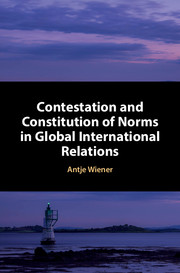
Wiener: Contestation and Constitution of Norms in Global International Relations
Antje Wiener examines the involvement of local actors in conflicts over global norms such as fundamental rights and the prohibition of torture and sexual violence. Providing accounts of local interventions made on behalf of those affected by breaches of norms, she identifies the constraints and opportunities for stakeholder participation in a fragmented global society. The book also considers cultural and institutional diversity with regard to the co-constitution of norm change. Proposing a clear framework to operationalize research on contested norms, and illustrating it through three recent cases, this book contributes to the project of global international relations by offering an agency-centred approach. It will interest scholars and advanced students of international relations, international political theory, and international law seeking a principled approach to practice that overcomes the practice-norm gap.
Monday, September 3, 2018
New Issue: Harvard International Law Journal
- Catherine Amirfar & Ashika Singh, The Trump Administration and the “Unmaking” of International Agreements
- Daniela Caruso, Non-Parties: The Negative Externalities of Regional Trade Agreements in a Private Law Perspective
- Courtney Hillebrecht & Alexandra Huneeus, with Sandra Borda, The Judicialization of Peace
- David A. Koplow, The Fault Is Not in Our Stars: Avoiding an Arms Race in Outer Space
Hamilton: Africa, the Court, and the Council
One of the defining narratives of the Court’s first 15 years of operation has been that it has an anti-Africa bias. This view, initially promulgated by individuals whom the Court sought to prosecute, moved into the mainstream and is now advanced through Africa’s regional body, the African Union. On the most strident telling of this narrative, the Court acts with animus against Africans, while purposefully shielding the most powerful States in the international system. (The ‘anti-Africa court’ narrative.) The counter-narrative to this, advanced by Court officials and their most ardent supporters, emphasizes that African countries were the earliest advocates of the Court; far from having an anti-Africa bias, the ICC is a court by and for Africa. This narrative is often linked to the idea that any claim of bias is presumptively untrue because decisions at the Court are made solely based on law. As the current ICC Prosecutor, Fatou Bensouda, has put it: ‘[T]he Prosecutor does not take into account any political considerations. These, we continue to say, belong to other institutions…. [The Office of the Prosecutor] has to scrupulously respect legal limits.’ On this view, law-like activity is a-political, therefore any charge of bias against a particular State or region is necessarily false. (The ‘a-political court’ narrative). There is, however, another perspective, which rejects the conflation of the terms legal and a-political, stressing instead the observation of Sarah Nouwen and Wouter Werner that law itself can be, and often is, both political and non-political. With this understanding in place, it becomes possible to move beyond a blanket denial of the idea that the Court could ever act politically, and engage substantively with the arguments of those who accuse it of doing so. This chapter looks at these issues through the relationship between the ICC, the U.N. Security Council, and the African Union.
Beer: Military Professionalism and Humanitarian Law: The Struggle to Reduce the Hazards of War
This book challenges the unacceptable gap between the positive rules of the international law governing armed hostilities and actual state practice. It discusses reducing the human suffering caused by this reality. The current law does not seem to be optimal in balancing the different interests of states' militaries and the humanitarian agenda. In response to this challenge, this book offers a new paradigm based on reality that may elevate the humanitarian threshold by replacing the currently problematic imperatives imposed upon militaries with professionally-based, therefore attainable, requirements. The aims of the suggested paradigm are to create an environment in which full abidance by the law becomes a realistic norm, thus facilitating a second, more important aim of reducing human suffering.
Militaries function in a professional manner; they develop and respect their doctrine, operational principles, fighting techniques and values. Their performances are not random or incidental. The suggested paradigm calls for leveraging the constraining elements that are latent in military professionalism. Talking professional language and adopting the professional way of thinking that underlies militaries' conduct makes it possible to identify and focus upon the core interests of a military in any given lawful war - those that ought to be taken into consideration - alongside those that can be sacrificed for the sake of the humanitarian concerns, while still allowing the military mission to be achieved. Indeed, leveraging professional standards and norms would establish a reasonable modus vivendi for a military, while allowing substantial new space for the humanitarian mission of the law.
Sunday, September 2, 2018
New Issue: Journal of International Arbitration
The latest issue of the Journal of International Arbitration (Vol. 35, no. 5, 2018) is out. Contents include:- Klaus Peter Berger, The Direct Involvement of the Arbitrator in the Amicable Settlement of the Dispute: Offering Preliminary Views, Discussing Settlement Options, Suggesting Solutions, Caucusing
- Michael W. Bühler, Out of Africa: The 2018 OHADA Arbitration and Mediation Law Reform
- Gordon Blanke, Free Zone Arbitration in the United Arab Emirates: DIFC v. ADGM: (Part I)
- Edgardo Muñoz, Mexican Punitive Damages in Commercial Arbitration: Forecasting the Future
- Mauro Megliani, Thou Shalt Not Arbitrate: Sovereign Debt and Investment Arbitration
Friday, August 31, 2018
Erie: The China International Commercial Court: Prospects for Dispute Resolution for the “Belt and Road Initiative”
Nadj: International Criminal Law and Sexual Violence against Women
This book explores the prosecution of wartime sexual violence in international criminal law and asks what the juridicalisation of gender-based violence signifies for women. The book explores the portrayal of the various gendered identities that surface in armed conflict and it asks whether the law is capable of reflecting these in subsequent judgements. Focusing on the International Criminal Tribunal for the Former Yugoslavia and the International Criminal Tribunal for Rwanda as well as subsequent developments in the International Criminal Court, the book shows how the tribunals have delivered landmark jurisprudence in the area of sexual violence against women and provided a legacy for how gender justice is incorporated into international law. However, Daniela Nadj argues that in the relevant cases there is a tendency to depict women in monolithic fashion with little agency or sense of identity beyond their ethnicity. By bringing to the surface the complexity and multi-faceted gendered identities in wartime, the book calls for a reconceptualisation of notions of femininity in armed conflict.
Dothan: The Three Traditional Approaches to Treaty Interpretation: A Current Application to the European Court of Human Rights
The Vienna Convention on the Law of Treaties sets the rules of treaty interpretation in articles 31-33. Yet these rules are quite vague, and they leave a lot of room for judicial discretion. The European Court of Human Rights (ECHR) has developed its own version of these rules of interpretation—a version that tracks the three traditional approaches to treaty interpretation: the textual approach, the subjective approach, and the teleological approach. Looking at the practice of the ECHR through the lens of these three traditional approaches highlights the logic of some of the court's interpretive choices, including its doctrine of deference: the Margin of Appreciation.
Call for Submissions: Military Law and the Law of War Review
The Military Law and the Law of War Review
Call for Papers
The Military Law and the Law of War Review / Revue de Droit Militaire et de Droit de la Guerre is a journal specialised in matters of interest for both civilian and military legal advisors as well as legal scholars and academics. Published since 1962, it is among the oldest publications at the international level in the areas of military/security law and the law of war. For decades, the Review has been an important forum of discussion for scholars and practitioners from all over the world.
The Review is published under the auspices of the International Society for Military Law and the Law of War. It features original and challenging articles, case notes, commentaries of the latest legal developments, as well as book reviews. As a distinct trait, it accepts contributions in six languages: English, French, German, Spanish, Italian and Dutch.
For its coming issue, the Review’s editorial board welcomes submissions from scholars and practitioners that come within the broader scope of the Review (including military law, law of armed conflict, law on the use of force, as well as international criminal law and human rights law (inasmuch as related to situations of armed conflict)).
The deadline for submission is 31 October 2018.
Submissions should be sent by e-mail to brussels@ismllw.org and will be subject to double-blind peer review. Articles should normally not be longer than 15.000 words (footnotes included), although longer pieces may exceptionally be considered. Inquiries as to whether a possible submission comes within the scope of the Review can be sent to the abovementioned e-mail address.
Selected papers will be published online on the Review’s website in advance access (in a non-downloadable and non-printable form) as well as on Hein Online following editing and type-setting. The print version of the issue will appear in the course of 2019.
Call for Papers: 2019 ILA-ASIL Asia-Pacific Research Forum
de la Rasilla del Moral: Playing Hide and Seek with ‘Vergangenheit, Die Nicht Vergehenwill’ (‘A Past that Will Not Pass’) in the History of International Law
The first part of the chapter reviews the enactment of the Spanish Historical Memory Act (HMA) and examines three of its most polemical areas of implementation in the light of the concerns several United Nations human rights bodies charged with overseeing the conflictual politics of historical memory in Spain have raised. The second part of the chapter builds on Spanish experience in examining some of the most common hurdles, including methodological ones, that an incoming democratic generation of international lawyers may face when attempting a balanced exploration of the history of international law after a long period of authoritarian rule in their home country.
New Issue: Journal of International Dispute Settlement
The latest issue of the Journal of International Dispute Settlement (Vol. 9, no. 3, September 2018) is out. Contents include:- Special Issue: Experts in the International Adjudicative Process
- Laurence Boisson de Chazournes, Hélène Ruiz Fabri, Makane Moïse Mbengue, Rukmini Das, & Guillaume Gros, The Expert in the International Adjudicative Process: Introduction to the Special Issue
- Mohamed Bennouna, Experts before the International Court of Justice: What for?
- James Flett, When is an Expert not an Expert?
- Geoffrey Senogles, Some Views from the Crucible: The Perspective of an Expert Witness on the Adversarial Principle
- Cherise Valles, Different Forms of Expert Involvement in WTO Dispute Settlement Proceedings
- Joan E Donoghue, Expert Scientific Evidence in a Broader Context
- Kate Cook, Judging ‘Best Available Science’: Emerging Issues and the Role of Experts
- Isabelle Van Damme, The Assessment of Expert Evidence in International Adjudication
- José E Alvarez, The Search for Objectivity: The Use of Experts in Philip Morris v Uruguay
- Marisa Goldstein, Legal Basis and Procedures for Consulting with Experts and International Organizations in WTO Dispute Settlement
- Philippe Gautier, Experts before ITLOS: An Overview of the Tribunal’s Practice
- Kate Parlett, Parties’ Engagement with Experts in International Litigation
- Mélida Hodgson & Melissa Stewart, Experts in Investor-State Arbitration: The Tribunal as Gatekeeper
- Brendan Plant, Expert Evidence and the Challenge of Procedural Reform in International Dispute Settlement
- Jean-Marc Sorel, Symposium—The Expert in the International Adjudicative Process: Concluding Observations
- Laurence Boisson de Chazournes, Makane Moise Mbengue, Rukmini Das, & Guillaume Gros, One Size does not Fit All—Uses of Experts before International Courts and Tribunals: An Insight into the Practice
- Current Developments
- Patrick Dumberry, Requiem for Crimea: Why Tribunals Should Have Declined Jurisdiction over the Claims of Ukrainian Investors against Russian under the Ukraine–Russia BIT
New Issue: Journal of the History of International Law / Revue d'histoire du droit international
The latest issue of the Journal of the History of International Law / Revue d'histoire du droit international (Vol. 20, no. 2, 2018) is out. Contents include:- Guy Fiti Sinclair, A ‘Civilizing Task’: The International Labour Organization, Social Reform, and the Genealogy of Development
- Melissa H. Loja, A Critical Legal Approach to the South China Sea Territorial Dispute
- Ivar Alvik, Protection of Private Property in the Early Law of Nations
Thursday, August 30, 2018
New Issue: American Journal of International Law
- Article
- Sergio Puig & Gregory Shaffer, Imperfect Alternatives: Institutional Choice and the Reform of Investment Law
- Essay
- Anthea Roberts, Incremental, Systemic, and Paradigmatic Reform of Investor-State Arbitration
- Editorial Comment
- In Memoriam
- International Decisions
- Angeliki Papantoniou, Advisory Opinion on the Environment and Human Rights
- Björn Arp, Slowakische Republik (Slovak Republic) v. Achmea B.V.
- Jonas Nilsson, Prosecutor v. Bemba et al.
- Nicolás Carrillo-Santarelli, Gender Identity, and Equality and Non-discrimination of Same Sex Couples
- Contemporary Practice of the United States Relating to International Law
- Jean Galbraith, Contemporary Practice of the United States Relating to International Law
- Recent Books on International Law
- John R. Crook, reviewing The Role of Legal Advisers in International Law, edited by Andraž Zidar and Jean-Pierre Gauci
- Saikrishna Bangalore Prakash, reviewing Waging War: The Clash Between Presidents and Congress 1776 to ISIS, by David J. Barron
- Teemu Ruskola, reviewing Queering International Law: Possibilities, Alliances, Complicities, Risks, edited by Dianne Otto
- Yutaka Arai-Takahashi, reviewing The Writing on the Wall: Rethinking the International Law of Occupation, by Aeyal Gross
- Theodor Meron,
Closing the Accountability Gap: Concrete Steps Toward Ending Impunity for Atrocity Crimes
- Charles N. Brower,
In Memoriam David D. Caron (1952–2018)
New Volume: Baltic Yearbook of International Law
- Martins Paparinskis, We Will Always Have International Law: Editorial Note
- Enrico Milano, Territorial Conflicts and Disputes in Europe: What Role for International Law in the 21st Century?
- Przemyslaw Tacik, Attribution of Responsibility after the EU Accession to the ECHR and the “Co-Respondent Mechanism”
New Issue: The Law and Practice of International Courts and Tribunals
The latest issue of The Law and Practice of International Courts and Tribunals (Vol. 17, no. 2, 2018) is out. Contents include:- Geir Ulfstein & Andreas Zimmermann, Certiorari through the Back Door? The Judgment by the European Court of Human Rights in Burmych and Others v. Ukraine in Perspective
- Millicent McCreath & Zoe Scanlon, Prospects for the Future Use of ITLOS Ad Hoc Special Chambers after the Ghana/Côte d’Ivoire Case
- Yateesh Begoore, Uniting for Enforcement: Resolving the World Court’s Enforcement Gap
- Patrick Dumberry, Terra Incognita: What Happens When a Problem of State Succession Occurs during Arbitration Proceedings?
- Arnaud de Nanteuil, Counterclaims in Investment Arbitration: Old Questions, New Answers?
- José M. Cortés-Martín, The Long Walk to Strasbourg: About the Insufficient Judicial Protection in Some Areas of the Common Foreign and Security Policy before the European Union’s Accession to the ECHR
Wednesday, August 29, 2018
New Issue: International Environmental Agreements: Politics, Law and Economics
The latest issue of International Environmental Agreements: Politics, Law and Economics (Vol. 18, no. 4, August 2018) is out. Contents include:- Harry Barnes-Dabban & Sylvia Karlsson-Vinkhuyzen, The influence of the Regional Coordinating Unit of the Abidjan Convention: implementing multilateral environmental agreements to prevent shipping pollution in West and Central Africa
- Andreas Kokkvoll Tveit, Can the management school explain noncompliance with international environmental agreements?
- Steinar Andresen, G. Kristin Rosendal, & Jon Birger Skjærseth, Regulating the invisible: interaction between the EU and Norway in managing nano-risks
- Elen Akopova, Assiya Nursapa, & Ilyas Kuderin, Current environmental problems in member states of the Eurasian Economic Union
- Fran Humphries, Sharing aquatic genetic resources across jurisdictions: playing ‘chicken’ in the sea
- Jen Iris Allan, David Downie, & Jessica Templeton, Experimenting with TripleCOPs: Productive innovation or counterproductive complexity?
- Jing Wu & Jean-Claude Thill, Climate change coalition formation and equilibrium strategies in mitigation games in the post-Kyoto Era
- Janina Heim, Max Krott, & Michael Böcher, Nomination and inscription of the “Ancient Beech Forests of Germany” as natural World Heritage: multi-level governance between science and politics
- Anne-Kathrin Weber, The revival of the Honourable Merchant? Analysing private forest governance at firm level
Summers & Gough: Non-State Actors and International Obligations: Creation, Evolution and Enforcement
- James Summers, Introduction
- Klara Polackova Van der Ploeg, Treaty Obligations of Collective Non-State Entities: The Case of the Deep Seabed Regime
- Michael Mulligan, The East India Company: Non-State Actor as Treaty-Maker
- Agata Kleczkowska, Armed Non- State Actors and Customary International Law
- Eva Kassoti, Ad Hoc Commitments by Non-State Armed Actors: The Continuing Relevance of State Consent
- Valentina Vadi, Exploring the Borderlands: The Role of Private Actors in International Cultural Law
- Federica Cittadino, Shaping the Convention on Biological Diversity: The Rising Importance of Indigenous Peoples within the Nagoya Protocol on Access and Benefit-Sharing
- Ekaterina Yahyaoui Krivenko, Exploring the Future of Individuals as Subjects of International Law: The Example of the Canadian Private Sponsorship of Refugees Programme
- Javier García Olmedo, Redefining the Position of the Investor in the International Legal Order and the Nature of Investment Treaty Rights: A Closer Look at the Relationship between Diplomatic Protection and Investor-State Arbitration
- Simone F. van den Driest, Tracing the Human Rights Obligations of UN Peacekeeping Operations
- Gintarė Pažereckaitė, An Elephant in the Room: the Scrutiny of the United Nations in the Practice of the European Court of Human Rights
- Ioana Cismas and Sarah Macrory, The Business and Human Rights Regime under International Law: Remedy without Law?
- Natalia Cwicinskaja, International Human Rights Law and Territorial Non-State Actors: Cases of the Council of Europe Region
- Emily Choo, The Impact of Non-State Actors’ Intervention in Investor-State Arbitration: A Further Study
- Tomas Vail, The Brčko Arbitration: A Process for Lasting Peace between Non-State Actors
- Adamantia Rachovitsa, International Law and the Global Public Interest: ICANN’s Independent Objector as a Mechanism of Responsive Global Governance
- Katharine Fortin, The Relevance of Article 9 of the Articles on State Responsibility for the Internationally Wrongful Acts of Armed Groups
- Tatyana Eatwell, State Responsibility, ‘Successful’ Insurrectional Movements and Governments of National Reconciliation
- Paloma Blázquez Rodríguez, Does an Armed Group have an Obligation to Provide Reparations to Its Victims? Construing an Obligation to Provide Reparations for Violations of International Humanitarian Law
- Anna Marie Brennan, Prosecuting Members of Transnational Terrorist Groups under Article 25 of the Rome Statute: A Network Theory Approach to Accountability
- Jeffrey Davis, NGO s in Terrorism Cases: Diffusing Norms of International Human Rights Law
New Issue: Journal of International Humanitarian Legal Studies
The latest issue of the Journal of International Humanitarian Legal Studies (Vol. 8, nos. 1-2, 2017) is out. Contents include:- Zia Akhtar, Naxalite Rebellion: Domestic Law and Order, and Humanitarian Law in a Non International Armed Conflict
- Matthew Bywater, Classical and Political Humanitarianisms in an Era of Military Interventionism and the War on Terror
- Grant Dawson & Rachel Laut, Human Mobility and Climate Change
- Michael John-Hopkins, Mapping War, Peace and Terrorism in the Global Information Environment
- Artem Sergeev, Applying Additional Protocol II of the Geneva Conventions to the United Nations Forces
Conference: 14th Annual Conference of the European Society of International Law (Reminder)
The 2018 conference will take a hard and unflinching look at the multitude of roles and functions played by universality in international legal discourses as well as its associated narratives of progress and virtues. In doing so, it will provide a critical appraisal of the mechanisms of inclusion and exclusion that come with international law and its universalist discursive strategies. This will require that universality is not reduced to the question of the geographical outreach of international law, but instead, is understood in terms of boundaries. This will also entail examining how the idea of universality – which does not lend itself to a translation in all languages – was developed in some of the dominant vernaculars of international law – primarily English and French – before being universalised and imposed upon international lawyers from all traditions. This will simultaneously offer an opportunity to revisit the ideologies that constitute the identity of international lawyers today, as well as the socialisation, reproduction and legal educational processes which they undergo to become international lawyers. Special attention will be paid to the place which Europe has secured for itself by virtue of the progress and historical narratives built around the idea of universality.
In recent decades, however, the virtues and ostensible progress commonly associated with universality have been contested. As is illustrated by the several generations of Third World Approaches to International Law, international lawyers have argued that universality can function as an ideology as well as an instrument of domination and exclusion. They have come to realise that the way in which universality is deployed in international legal discourses constantly creates a periphery and an otherness which suppresses memory and struggle. Just as the use of the idea of humanity fuelled scepticism in the middle of the 20th century (see e.g. Schmitt), the invocation of universality has come to arouse suspicion among international lawyers. For many TWAIL and post-colonialist theorists, “whoever invokes universality wants to cheat”.