“If I look at the mass I will never act. If I look at one, I will.” This statement, uttered by Mother Teresa, captures a powerful and deeply unsettling insight into human nature: Most people are caring and will exert great effort to rescue “the one” whose needy plight comes to their attention. But these same people often become numbly indifferent to the plight of “the one” who is part of a much greater problem. Why does this occur? The answer to this question will help us answer a related question: Why do good people and their governments ignore mass murder and genocide?
Wednesday, April 7, 2010
Slovic: Can International Law Stop Genocide When Our Moral Intuitions Fail Us?
Paul Slovic (Univ. of Oregon - Psychology) has posted Can International Law Stop Genocide When Our Moral Intuitions Fail Us? (in Behavior and Policy, E. Shafir ed., 2009). Here's the abstract:

New Issue: Virginia Journal of International Law
 The latest issue of the Virginia Journal of International Law (Vol. 50, no. 3, Spring 2010) is out. Contents include:
- Letter from John B. Bellinger, III
- Mario Silva, Somalia: State Failure, Piracy, and the Challenge to International Law
- Christopher M. Bruner, Power and Purpose in the “Anglo-American” Corporation
- John F. Coyle, Incorporative Statutes and the Borrowed Treaty Rule
- Robert C. Bird & Peggy E. Chaudhry, Pharmaceuticals and the European Union: Managing Gray Markets in an Uncertain Legal Environment
Davis, Kingsbury, & Merry: Indicators as a Technology of Global Governance
Kevin E. Davis (New York Univ. - Law), Benedict Kingsbury (New York Univ. - Law), & Sally Engle Merry (New York Univ. - Anthropology) have posted Indicators as a Technology of Global Governance. Here's the abstract:
The use of indicators is a prominent feature of contemporary global governance. Indicators are produced by organizations ranging from public actors such as the World Bank or the US State Department, to NGOs such as Freedom House, to hybrid entities such as the Global Fund, to private sector political risk rating agencies. They are used to compare and rank states for purposes as varied as deciding how to allocate foreign aid or investment and whether states have complied with their treaty obligations. This article defines the concept of an “indicator,” describes how indicators have recently been used in global governance, and identifies various ways in which the use of indicators has the potential to alter the nature of global governance. Particular attention is paid to how reliance on indicators affects the authority and contestability of decisions. The United Nations Human Development Index and the World Bank Doing Business indicators are analyzed as case studies.
ASIL Scholarship Awards
Each year, at its annual meeting, the American Society of International Law bestows a number of book and article awards. Here are those presented at the 2010 annual meeting:
- Certificate of Merit for a preeminent contribution to creative scholarship: Beth Simmons, Mobilizing for Human Rights: International Law in Domestic Politics (Cambridge Univ. Press 2009).
- Certificate of Merit in a specialized area of international law: Mark Osiel, The End of Reciprocity: Terror, Torture, and the Law of War (Cambridge Univ. Press 2009).
- Certificate of Merit for high technical craftsmanship and utility to practicing lawyers and scholars: Chester Brown, A Common Law of International Adjudication (Oxford Univ. Press 2007).
- Francis Deák Prize: Jacob Katz Cogan, Representation and Power in International Organization: The Operational Constitution and Its Critics, 103 AJIL 209 (2009), and Galit A. Sarfaty, Why Culture Matters in International Institutions: The Marginality of Human Rights at the World Bank, 103 AJIL 647 (2009).
- Lieber Prize: (book) James A. Green, The International Court of Justice and Self-Defense in International Law (Hart Publishing 2009), and (article) Robert Sloane, The Cost of Conflation: Preserving the Dualism of the Jus ad Bellum and the Jus in Bello in the Contemporary Law of War, 34 Yale Journal of International Law 47 (2009).
- Lieber Society Military Prize: Sean Watts, Combatant Status and Computer Network Attack, 50 Virginia Journal of International Law 391 (2010).
- Private International Law Prize: Alex Mills, "Subsidiarity and the Conflict of Laws in the European Union and United States."
Also noteworthy is the election or re-election of four individuals to the American Journal of International Law's Board of Editors. They include: Christine M. Chinkin; John R. Crook (re-elected); Laurence R. Helfer; and Ruth Wedgwood.
Workshop: de Búrca
Gráinne de Búrca (Fordham Univ. - Law) will give a talk today at the New York University School of Law Institute for International Law and Justice International Legal Theory Colloquium on "EU International Relations: The Governance Mode of Foreign Policy."
Tuesday, April 6, 2010
Symposium: International Finance after the Crash: Regional Responses to the Global Financial Crisis
Later this week, on April 9, 2010, the Global Business Law Review will host its first annual symposium. The topic is "International Finance after the Crash: Regional Responses to the Global Financial Crisis." The program is here.
Stone Sweet: Investor-State Arbitration: Proportionality's New Frontier
Alec Stone Sweet (Yale Univ. - Law and Political Science) has posted Investor-State Arbitration: Proportionality's New Frontier (Law and Ethics of Human Rights, forthcoming). Here's the abstract:
The arbitral world is at a crucial point in its historical development, poised between two conflicting conceptions of its nature, purpose, and political legitimacy. Formally, the arbitrator is an agent of the contracting parties in dispute, a creature of a discrete contract gone wrong. Yet, increasingly, arbitrators are treated as agents of a larger global community, and arbitration houses concern themselves with the general and prospective impact of important awards. In this paper, I address these questions, first, from the standpoint of delegation theory. In Part I, I introduce the basic “Principal-Agent” framework [P-A] used by social scientists to explain why actors create new institutions, and then briefly discuss how P-A has been applied to the study of courts. Part II uses delegation theory to frame discussion of arbitration as a mode of governance for transnational business and investment. In Part III, I argue that the International Center for the Settlement of Investment Disputes (ICSID) is presently in the throes of judicialization, indicators of which include the enhanced use of precedent-based argumentation and justification, the acceptance of third-party briefs, and a flirtation with proportionality balancing. Part IV focuses on the first wave of awards rendered by ICSID tribunals pursuant to Argentina’s response to the crushing economic crisis of 2000-02, wherein proportionality emerged, adapted from the jurisprudence of the Appellate Body of the World Trade Organization.
Shaffer: Risk, Science and the Law in the WTO: The Centrality of Institutional Choice
Gregory Shaffer (Univ. of Minnesota - Law) has posted Risk, Science and the Law in the WTO: The Centrality of Institutional Choice. Here's the abstract:
It is sometimes observed that in our complex, technologically-dynamic world, legal institutions attempt to import science into law and export law’s problems to science. This essay assesses the relation of risk, science and law in the World Trade Organization (WTO). It responds to the question what ought a WTO panel to do in light of the texts of the WTO agreements. Although it focuses on the Agreement on Sanitary and Phytosanitary Measures, it provides a general framework of analysis. At a first order of analysis, the essay notes how we can view WTO dispute settlement as involving a double delegation of authority to two non-majoritarian institutions for resolving disputes over risk regulation that affects trade: (i) step 1: a quasi-judicial body; (ii) step 2: independent scientific experts who cognitively shape the way the judicial body views the issues. From a second order of analysis, however, WTO panels and the Appellate Body face interpretive choices of how to weigh science and the application of a risk assessment that will have institutional implications. The essay views the interpretive choices as implicating different allocations of institutional authority, which are categorized into five ideal types. The essay contends that the choice of process-based review is typically the best one, since it is one where judicial panels have relative experience and capacity. Yet it also maintains that WTO panels have good reason to maintain the option of engaging in more than purely procedural review, while remaining aware of the limitations of scientific methods. The arguments were presented at the ASIL annual meeting in 2010.
Coyle: Rethinking the Commercial Law Treaty
John Coyle (Harvard Univ. - Law) has posted Rethinking the Commercial Law Treaty (Georgia Law Review, forthcoming). Here's the abstract:
In international commercial transactions, it is not always clear which state’s law will apply to govern a particular contract. Historically, states have sought to address this problem by means of two types of treaties. The first aims to solve the problem by bringing about the substantive unification of commercial law across multiple jurisdictions; once the law is everywhere the same, then it no longer matters which state’s law applies to govern the contract. The second aims to solve the problem in part by empowering the transacting parties to choose the law that will govern their contract; once these parties know that their choice of law will be respected by national courts, then the uncertainty as to the governing law goes away.
The conventional wisdom has long been that substantive unification represents the better approach to solving the problem of legal uncertainty. This Article challenges that conventional wisdom to argue that, in fact, a choice-of-law approach may be superior. It does so, first, by identifying weaknesses in the two rationales that have most frequently been advanced in favor of substantive commercial law treaties – that they are uniquely able to reduce transaction costs and that they offer law uniquely suited to the needs of international commercial transactions. The Article then explains how a choice-of-law treaty could lead to the development of better commercial law that more accurately captures the preferences of parties engaged in international commerce by facilitating the development of an international market for commercial law.
Workshop: Shaffer
Gregory Shaffer (Univ. of Minnesota - Law) will give a talk today at the Temple University School of Law International Law Colloquium on "Who Decides: A Comparative Institutional Approach to WTO Dispute Settlement."
Monday, April 5, 2010
Bessone & Delpla: Peines de guerre
 Magali Bessone & Isabelle Delpla have published Peines de guerre: La justice pénale internationale et l'ex-Yougoslavie (Éditions de l'École des hautes études en sciences sociales 2010). Contents include:
- Isabelle Delpla, Introduction. La réception du TPIY : héritage philosophique, contingence historique, universalité morale
- Stéphanie Maupas, Bref historique. Le TPIY et la politique pénale du Bureau du procureur
- Joseph Krulic, Les procès Mihailović et Stepinac de 1946 au regard des critères du procès equitable
- Yann Jurovics, Sur les catégories juridiques de crime contre l'humanité et de genocide
- Xavier Bougarel, Du code pénal au mémorandum. Les usages du terme génocide dans la Yougoslavie communiste
- Petar Novoselec, Conception de la peine dans la philosophie et le droit pénal d'ex-Yougoslavie
- Ivan Vuković, La philosophie pénale en ex-Yougoslavie. Un episode
- Jan Christoph Nemitz, La pratique en matières de peines du TPIY
- Vladimir Petrovic, Les historiens comme témoins experts au TPIY
- John B. Allcock, Le praticien des sciences sociales en qualité d'expert et de témoin
- Romana Schweiger, Entre recherche de la vérité et pragmatisme le plea bargaining au TPIY et en Bosnie-Herzégovine
- Wolfgang Schomburg, Sur le rôle des procédures dans l'établissement de la vérité
- Magali Bessone, Apories de la transparence au TPIY
- Samuel Tanner, Crimes de masse et justice en ex-Yougoslavie. Une ethnographie de quatre exécuteurs serbes
- Klaus Buchenau, Les Églises et le TPIY. Perspectives serbe orthodoxe et croate catholique
- Christian Moe, La justification du statut de victime. La réception du TPIY par les musulmans de Bosnie-Herzégovine
- Elissa Helms, Justice et genre. Mobiliser les survivantes de guerre bosniaques
- Isabelle Delpla, Catégories juridiques et cartographie des jugements moraux. Le TPIY évalué par victimes, témoins et condamnés
Sadat: Unpacking the Complexities of International Criminal Tribunal Jurisdiction
Leila N. Sadat (Washington Univ. in St. Louis - Law) has posted Unpacking the Complexities of International Criminal Tribunal Jurisdiction. Here's the abstract:
This essay discusses the many overlapping and important aspects of the jurisdiction of international criminal courts and tribunals, and particularly their constitutional function in the international legal order. It canvasses the jurisdictional provisions of 8 current and former war crimes tribunals and the permanent International Criminal Court to distill the fundamental jurisdictional provisions of each one as to temporal, geographic, subject matter and personal jurisdiction. The principles of complementarity and primacy are also discussed and evaluated as principles of international criminal law policy and practice.
Lavranos: Protecting European Law from International Law
Nikos Lavranos (The Hague Univ. - Law) has posted Protecting European Law from International Law (European Foreign Affairs Review, Vol. 15, No. 1, pp. 265-282, 2010). Here's the abstract:
This contribution analyses the relationship between international law and Community law in the light of two recent European Court of Justice (ECJ) cases on Article 307 EC, that is, the Kadi and bilateral investment treaties (BITs) judgments. The analysis discusses two concepts: (1) the concept of the ‘very foundations of the Community legal order’ and (2) the concept of ‘hypothetical incompatibility’. The main argument that is advanced in this contribution is that with these two concepts, the ECJ has identifi ed a constitutional dimension of Article 307 EC that hitherto has not been generally recognized. More specifically, it is argued that the main aim and result of this new line of jurisprudence is to protect the autonomy of European law from international law interferences by excluding as much as possible any confl icts between European and international law.
In this sense, Article 307 EC is a tool for the ECJ to act as a gatekeeper by regulating the relationship between international law and Community law. Moreover, it is argued that the concept of the ‘very foundations of the Community legal order’ very much resembles the approach of the Federal German Constitutional Court, which in turn illustrates that the ECJ is performing the function of a true constitutional court of Europe. Accordingly, this article links up the external relations aspects of Article 307 EC with the closely connected internal constitutional aspects.
de Beco: Non-Judicial Mechanisms for the Implementation of Human Rights in European States
 Gauthier de Beco (Catholic Univ. of Louvain) has published Non-Judicial Mechanisms for the Implementation of Human Rights in European States (Bruylant 2010). Here's the abstract:
This book deals with non-judicial mechanisms for the implementation of human rights in European states. Human rights have been recognised through various human rights instruments. However, achieving compliance with human rights requires more than just creating, clarifying or expanding human rights standards. Human rights treaties also need concrete responses within domestic systems to allow these treaties to function. This requires that states create non-judicial mechanisms for the implementation of human rights. Four such mechanisms are studied in the book: national human rights institutions (NHRIs), human rights indicators, human rights impact assessments (HRIAs) and national human rights action plans (NHRAPs). These non-judicial mechanisms have recently been developed by European states, but they have not been much discussed. Their creation requires a different approach to human rights than those approaches that focus on their judicial application by human rights bodies. The book aims to provide an in-depth insight into the non-judicial mechanisms and includes discussions of both their theoretical and practical aspects.
In the introduction, the author argues that human rights should be implemented principally at the national level. In view of this, states should endeavour to achieve compliance with both civil and political and economic, social and cultural rights. This requires that they establish non-judicial mechanisms that strengthen their national human rights systems. Doing so is a procedural requirement that defines the way in which states should implement human rights. Non-judicial mechanisms can simultaneously prevent human rights violations, monitor human rights implementation and create a human rights dialogue. The four non-judicial mechanisms for the implementation of human rights studied in this book help states achieve these objectives. They all do this in their own respect, addressing the problem from a specific angle. First, NHRIs are the institutional instrument. While interacting with both state and non-state actors, they both monitor governmental action and provide advice to government, and promote and provide education on human rights. Second, human rights indicators are the measuring instrument. They allow the extent to which a state complies with human rights to be measured, thereby evaluating its progress in the realisation of human rights. Third, HRIAs are the policy instrument.
They evaluate the impact on human rights of both past and future policies. Fourth, NHRAPs are the holistic instrument. They establish a full programme that aims to realise human rights. The four non-judicial mechanisms described are both complementary and interdependent, and therefore constitute instruments that should be collectively established by European states in order to implement human rights. In the conclusion, the author examines the possibility of the use of non-judicial mechanisms for actors other than states as well as the mutual exchange of experiences regarding these non-judicial mechanisms.
Lecture: Osiel on "Globalizing Lawyers: A Sociology of International Finance Practice"
Mark Osiel (Univ. of Iowa - Law) will deliver a lecture today at the Duke University School of Law Center for International and Comparative Law on "Globalizing Lawyers: A Sociology of International Finance Practice."
Sunday, April 4, 2010
Benzing: Das Beweisrecht vor internationalen Gerichten und Schiedsgerichten in zwischenstaatlichen Streitigkeiten
 Markus Benzing has published Das Beweisrecht vor internationalen Gerichten und Schiedsgerichten in zwischenstaatlichen Streitigkeiten (Springer 2010). Here's the abstract:
Vor dem Hintergrund einer immer größer werdenden Zahl zwischenstaatlicher Gerichtsverfahren, in denen verstärkt auch Tatsachenfragen streitig sind, untersucht die Dissertation die Grundsätze der Tatsachenfeststellung und -würdigung vor internationalen Gerichten und Schiedsgerichten. Sie bietet eine systematische Darstellung und kritische Betrachtung des geltenden völkerrechtlichen Beweisrechts und unterbreitet Vorschläge für seine Fortentwicklung. Dabei trägt die Arbeit besonders den Umständen Rechnung, dass die internationale Gerichtsbarkeit kein kohärentes, in sich geschlossenes System darstellt und dass prozessrechtliche und gerade beweisrechtliche Fragen oft nur rudimentär in den gerichtseinsetzenden Verträgen geregelt sind.
Saturday, April 3, 2010
Lovric: Deference to the Legislature in WTO Challenges to Legislation
 Daniel Lovric has published Deference to the Legislature in WTO Challenges to Legislation (Kluwer Law International 2009). Here's the abstract:
Challenges to domestic legislation before international tribunals are a growing phenomenon in public international law. Consequently, in the field of global trade, the degree of deference given by WTO tribunals to domestic legislatures in challenges to their legislation is an area of increasing importance to practitioners, government officials and academics.
This timely work takes a new perspective on the way domestic law is treated at the international level. Using techniques of domestic constitutional law, it examines how international tribunals have treated challenges to legislation. The particular focus is WTO tribunals, but the book also draws on experiences from other international adjudicators, such as the European Court of Human Rights. Drawing from these examples, the author examines how international tribunals have (or have not) deferred to the opinions of the domestic legislature, and the legal techniques they've used in doing so. The treatment is detailed and comprehensive, contrasting and summarizing the relevant WTO case law.
Friday, April 2, 2010
Darge: Kriegsverbrechen im nationalen und internationalen Recht: Unter besonderer Berücksichtigung des Bestimmtheitsgrundsatzes
 Tobias Darge has published Kriegsverbrechen im nationalen und internationalen Recht: Unter besonderer Berücksichtigung des Bestimmtheitsgrundsatzes (Springer 2010). Here's the abstract:
Die durch das Römische Statut des Internationalen Strafgerichtshofes angestoßenen Entwicklungen im Völkerstrafrecht führen dazu, dass auch auf der nationalen Ebene Rechtsgrundlagen zur Verfolgung von Verbrechen gegen das Völkerrecht notwendig werden. Das neue deutsche Völkerstrafgesetzbuch steht dabei vor der Herausforderung, einerseits das geltende Völkerstrafrecht in nationales Recht zu transponieren, sich dabei aber andererseits im vorgegebenen Rahmen des Grundgesetzes zu halten, namentlich was die Einhaltung des Bestimmtheitsgrundsatzes betrifft. Der Autor geht der Frage nach, wie dieser Balanceakt im besonders komplexen Recht der Kriegsverbrechen gelungen ist. Er entwickelt Auslegungsgrundsätze und wendet diese auf als problematisch erkannte Tatbestände an.
New Issue: Journal du Droit International
 The latest issue of the Journal du Droit International ("Clunet") (Vol. 137, no. 1, Janvier-Février-Mars 2010) is out. Contents include:
- Doctrine
- Isabelle Barrière Brousse, Le Traité de Lisbonne et le droit international privé
- Marie Ganthous, La valeur internationale de la Constitution à la lumière de la Résolution 1757 (2007) créant le Tribunal spécial pour le Liban (TSL)
- Vélérie Varnerot, La transnationalisation du droit de brevet de médicaments : l'approche ADPIC- moins à rebrousse-poil
- Variétés
- Patrick Patelin & Geraldine Mirelman, La gouvernance d'entreprise en droit argentin
Hobér, Magnusson, & Öhrström: Between East and West: Essays in Honour of Ulf Franke
 Kaj Hobér, Annette Magnusson & Marie Öhrström have published Between East and West: Essays in Honour of Ulf Franke (Juris Publishing 2010). The table of contents is available here.
Bodansky: Climate Change and Human Rights: Unpacking the Issues
Daniel Bodansky (Univ. of Georgia - Law) has posted Climate Change and Human Rights: Unpacking the Issues (Georgia Journal of International and Comparative Law, forthcoming). Here's the abstract:
Global warming is expected to contribute to many human wrongs: disease, malnutrition, flooding of coastal communities. But does every human wrong violate a human right? Should we conceptualize climate change not only as an environmental problem – the preeminent one of our time – but also as a human rights violation? Proposals to treat climate change as a human rights problem raise many fundamental questions. Theoretically, what does it mean to conceptualize climate change in human rights terms? How would a human rights approach differ from treating climate change as an environmental or economic or scientific problem? Descriptively, what does human rights law say about climate change and, conversely, what does climate change law say about human rights? Normatively, does it make sense to approach climate change as a human rights issue? What are the pros and cons? This brief introduction to a symposium issue of the Georgia Journal of International and Comparative Law on climate change and human rights seeks to map out the overarching distinctions and questions.
Workshop: Brunnée
Jutta Brunnée (Univ. of Toronto - Law) will give a talk today at the University of Georgia School of Law International Law Colloquium Series on "An Interactional Theory of International Legal Obligation."
Thursday, April 1, 2010
Call for Submissions: Eyes on the ICC
 Eyes on the ICC has issued a call for submissions for its forthcoming volume. Here's the call:
Eyes on the ICC is the first peer-reviewed interdisciplinary journal dedicated exclusively to the work of the International Criminal Court and international criminal law.
The journal, published annually by the Council for American Students in International Negotiations, invites quality submissions for its 7th volume from practitioners, scholars, jurists, and professionals in fields related to international criminal law and policy. Occasionally, exceptional student work will be accepted. Manuscripts are accepted on a rolling basis until July 15, 2010.
Manuscripts must be computer-generated and submitted electronically via e-mail to the Managing Editor, Ms. Yasmin Tabi at yasmin@americanstudents.us, or via Berkeley Electronic Press’s ExpressO submission service, at http://law.bepress.com/expresso.
Each submission should contain an abstract, the author’s CV, appropriate contact information and a cover letter to the editor assuring that the manuscript has not been submitted or published elsewhere. Articles and Notes may range in length from 25 to 80 pages, double-spaced, and book reviews from 1,000 to 2,500 words. Submissions should adhere closely to the Chicago Manual of Style and cite sources in legal format according to the Harvard Blue Book.
Authors are encouraged to seek comments on their manuscripts from colleagues within their discipline. The journal invites commentary on the quality of its submissions, whether by private correspondence or published letter.
Correspondence not directly related to the submission process should be addressed to the Editor-in-Chief, Mr. Bernhard Kuschnik at bernhard@americanstudents.us.
Tiefenbrun: Decoding International Law: Semiotics and the Humanities
 Susan Tiefenbrun (Thomas Jefferson School of Law) has published Decoding International Law: Semiotics and the Humanities (Oxford Univ. Press 2010). Here's the abstract:
Violations of international law and human rights laws are the plague of the twentieth and twenty-first centuries. People's inhumanity to people escalates as wars proliferate and respect for human rights and the laws of war diminish. In Decoding International Law: Semiotics and the Humanities, Professor Susan Tiefenbrun analyzes international law as represented artfully in the humanities.
Mass violence and flagrant violations of human rights have a dramatic effect that naturally appeals to writers, film makers, artists, philosophers, historians, and legal scholars who represent these horrors indirectly through various media and in coded language. This reader-friendly book enables us to comprehend and decode international law and human rights laws by interpreting meanings concealed in great works of art, literature, film and the humanities. Here, the author adopts an interdisciplinary method of interpretation based on the science of signs, linguistics, stylistics, and an in-depth analysis of the work's cultural context. This book unravels the complexities of such controversial issues as terrorism, civil disobedience, women's and children's human rights, and the piracy of intellectual property.
It provides in-depth analyses of diverse literary works: Joseph Conrad's The Secret Agent and the movie Hotel Rwanda (both representing terrorism); Martin Luther King's Letter from Birmingham Jail; two documentary films about women and family law in Iran, Divorce Iranian Style and Two Women; Lisa See's Snow Flower and the Secret Fan (women's human rights and human trafficking in China); Uzodinma Iweala's Beasts of No Nation (shedding light on child soldiering and trafficking in Africa), and much more.
Jacobs: Puzzling Over Amnesties: Defragmenting the Debate for International Criminal Tribunals
Dov Jacobs (European Univ. Institute) has posted Puzzling Over Amnesties: Defragmenting the Debate for International Criminal Tribunals (in The Fragmentation of International Criminal Law, forthcoming). Here's the abstract:
Amnesties have been in debate for some time now in international circles.From an international law perspective, it should be pointed out something that is sometimes lost in the vast literature on the topic in international legal discussions: there is virtually no mention of amnesties in international documents. As we will see, in the dense web of human rights and international humanitarian law treaties, there is an explicit mention of amnesties in only one provision: an additional protocol to the Geneva Conventions relating to non-international armed conflict. This is mostly true of international criminal law. Even if some international(ized) tribunals include provisions on amnesties, justified by a particular local situation, the Statute of the International Criminal Court makes no mention of them. This leads to the somewhat peculiar situation that entire theories are constructed on the place of a concept in a legal order that makes hardly any reference to that concept in its constitutive documents. Despite this, or maybe because of this, amnesties have come up in relation to various fields of international law (human rights, international humanitarian law, and international criminal law) and in relation to various concepts of international law (most notably the duty to prosecute). This has created a risk of fragmentation on the issue that might threaten the unity of the concept. To take stock of this fragmented situation, we have chosen not to embark on a general theory on amnesties. Rather, we will try to answer a simple question: how must international criminal tribunals deal with amnesties for international crimes? The advantage of such a specific question is that it will focus the discussion, while still allowing us to draw a picture of the fragmented debate on amnesties in international.
The paper aims at defragmenting the debate on amnesties by decomposing the various levels at which it is discussed. First of all it looks at amnesties as perceived in various areas of international law, specifically human rights law and international humanitarian law. It then looks at how different international criminal tribunals have dealt with the question of amnesties. It then considers vertical fragmentation (national courts vs International courts) and pluridisciplinary fragmentation (perceptions from law, sociology, philosophy and political science). In a final section, the article proposes to see what are the relevant aspects of the debate specifically for international tribunals and suggests that we should move away from issues of legality to consider issues of recognition, which make the debate far more easy to solve.
Melloh: Einheitliche Strafzumessung in den Rechtsquellen des ICC-Statuts
 Florian Melloh has published Einheitliche Strafzumessung in den Rechtsquellen des ICC-Statuts (Duncker & Humblot 2010). Here's the abstract:
Florian Melloh legt in der vorliegenden Publikation die Grundlagen für eine einheitliche Strafzumessung im ICC-Statut. Er berücksichtigt dabei Gedanken der Gleichbehandlung und des Entscheidungsprozesses. Diese verweisen auf normative Mechanismen in den Rechtsquellen des ICC-Statuts: Der Autor belegt und vereint eine Völkerstraftheorie als Rechtfertigung von Strafe und Strafmaß, weist eine Strafzumessungsmethode nach und bestimmt die Bezugspunkte der Strafe. Weiterhin zeigt er wesentliche Strafzumessungsumstände auf, verdichtet Verhältnismäßigkeit und Graduierung zu einer Strafstruktur und beleuchtet die Strafzumessungsinformation im Prozess. Er befürwortet Richtlinienurteile, lehnt aber Strafzumessungsrichtlinien ab. Darüber hinaus erschließt er die Pflicht und den Umfang zur Begründung der Strafe und zur richterlichen Kontrolle der Strafzumessungsentscheidung. Florian Melloh schließt die Publikation mit dem Ausblick auf eine mögliche Strafstruktur im ICC-Statut ab.
New Volume: Yearbook of International Humanitarian Law
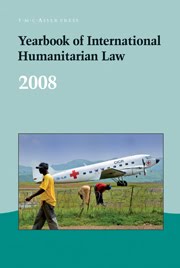 The latest volume of the Yearbook of International Humanitarian Law (Vol. 11, 2008) is out. Contents include:
- Th. A. van Baarda, Moral ambiguities underlying the laws of armed conflict: a perspective from military ethics
- Dan Kuwali, Protect responsibly: the African Union's implementation of Article 4(H) intervention
- Ola Engdahl, The status of peace operation personnel under international humanitarian law
- Ray Murphy & Declan Gannon, Changing the landscape: Israel's gross violations of international law in the occupied Syrian Golan
- James P. Benoit, Mistreatment of the wounded, sick and shipwrecked by the ICRC study on customary international humanitarian law
- Current Developments
- Benjamin To, The year in review
- Amna Guellali & Enrique Carnero Rojo, International criminal courts round-up
- Nina H. B. Jørgensen, The extraordinary chambers in the courts of Cambodia and the progress of the 'Khmer Rouge trials'
- Nout van Woudenberg & Wouter Wormgoor, The Cluster Munition Convention: around the world in one year
Besson & Tasioulas: The Philosophy of International Law
 Samantha Besson (Univ. of Fribourg - Law) & John Tasioulas (Univ. of Oxford - Philosophy) have published The Philosophy of International Law (Oxford Univ. Press 2010). Contents include:
- Benedict Kingsbury & Benjamin Straumann, State of Nature versus Commercial Sociability as the Basis of International Law: Reflections on the Roman Foundations and Current Interpretations of the International Political and Legal Thought of Grotius, Hobbes and Pufendorf
- Amanda Perreau-Saussine, Immanuel Kant on International Law
- Allen Buchanan, The Legitimacy of International Law
- John Tasioulas, The Legitimacy of International Law
- Thomas Christiano, Democratic Legitimacy and International Institutions
- Philip Pettit, Legitimate International Institutions: A Neo-Republican Perspective
- Samantha Besson, Theorizing the Sources of International Law
- David Lefkowitz, The Sources of International Law: Some Philosophical Reflections
- Andreas Paulus, International Adjudication
- Donald Regan, International Adjudication: A Response to Paulus - Courts, Custom, Treaties, Regimes, and the WTO
- Timothy Endicott, The Logic of Freedom and Power
- Jean Cohen, Sovereignty in the Context of Globalization: A Constitutional Pluralist Perspective
- James Crawford & Jeremy Watkins, International Responsibility
- Liam Murphy, International Responsibility
- Joseph Raz, Human Rights without Foundations
- James Griffin, Human Rights and the Autonomy of International Law
- John Skorupski, Human Rights
- Will Kymlicka, Minority Rights in Political Philosophy and International Law
- Jeremy Waldron, Two Conception of Self Determination
- Thomas Pogge, The Role of International Law in Reproducing Massive Poverty
- Robert Howse & Ruti Teitel, Global Justice, Poverty and the International Economic Order
- James Nickel & Daniel Magraw, Philosophical Issues in International Environmental Law
- Roger Crisp, Ethics and International Environmental Law
- Jeff McMahan, The Laws of War
- Henry Shue, Laws of War
- Thomas Franck, Humanitarian Intervention
- Danilo Zolo, Humanitarian Militarism?
- David Luban, Fairness to Rightness: Jurisdiction, Legality, and the Legitimacy of International Criminal Law
- Antony Duff, Authority and Responsibility in International Criminal Law
Subscribe to:
Posts (Atom)